7
A QUESTION OF REVELATION
The Principle Function
of Revelation in NCAY

Q. NCAY has, as one of its fundamental beliefs, the relevance of revelation to the modern world. From time to time we hear of revelations being received by different churches -- visions, and the occasional prophetic word. The content of these revelations varies widely and sometimes they contradict the Bible. The major established churches reject all forms of modern revelation, especially written revelation, because they maintain that the Bible is Yahweh's only written Davar (Word) to us today. I can understand their scepticism when they see the contradictory materials coming our from various evangelical groups, Mormons, etc.. So what does NCAY have to say in this matter?
A. Well, to begin with, may I say that NCAY is also very sceptical of much of the revelatory material that is floating about and it would be true to say that we reject the vast majority of it. However, scepticism should not lead us to abandon the idea of revelation. When the Bible was first canonised a veritable mass of documents claiming divine inspiration were floating about and it took the Messianic Community (Church) centuries to arrive at the canon it has today, weeding out that which was human fantasy. Sometimes in their enthusiasm the councils responsible for formulating the canon were too hasty and weeded out documents that we regard as inspired.
Q. Such as?
A. Such as the apocryphal book, accepted by the Catholics, The Wisdom of Yah'shua (Jesus) the son of Sirach, which in spirit and doctrine is almost identical to the Tanakh (Old Testament) books of Proverbs and Ecclesiastes.
Q. Granted that the councils were over enthusiastic sometimes, hasn't the outcome been desirable? If they had been less strict, might dubious books have found their way into the Scriptures that might have led people astray and have discredited the Bible?
A. I agree. In case of a cancer infection is better to cut out too much than too little, just to be on the safe side. And this indeed is what we have done with our own revelations, throwing out anything which might be misunderstood or sealing them away for study by those who are more spiritually sensitive and able to discern their meaning.
Q. And that is why so little is made public now, is it not?
A. Yes. The deeper mysteries, like the mechanics of the atonement, are best left to those capable of understanding it. Giving deep revelations to the public is like giving a loaded gun to a child. I remember when as a teacher a student came up to me and asked how to make explosives. As a radical Moslem his intention was to build a bomb and do some mischief to some Israeli office in London. In the hands of a sensible person, the formula for explosive manufacture can be used for positive uses, like dynamiting quarries, but in this young man's hands would have been fatal. Indeed, he was subsequently arrested for attempting to rob a bank with a dummy grenade and was deported from the country.
The emet (truth) is explosive because it changes your life. A revelation from Elohim (God) is not something you read for amusement or entertainment. When you read of Messiah's challenge to repent from sin in the New Testament you are not supposed to close your Bible and forget about it - you are supposed to repent! A Jew, who has only accepted the Tanakh (Old Testament) when he discovers, and is converted to, the New Testament, cannot continue hating his enemies - he must now love them. The Davar Elohim (Word of God) is given to be obeyed.
Q. But if you in NCAY receive revelation from Elohim (God), then surely it should be published to the world, like the Bible?
A. No, not at all. A revelation that is personal to me may be just that - personal. A revelation, once published, makes the person who reads it responsible - accountable. Think about it - if a revelation comes saying that being a fascist is incompatible with the Christian faith then no Christian should be a fascist!
Q. But surely the New Testament implies that anyway?
A. Certainly it does, for those who are bothered to find out what the requirements of the Christian faith are. But implication can be sidetracked, 'explained away'. My goodness me - did you know that Hitler was a baptised Catholic all his life? He was never excommunicated! Yet he was a mass-murderer. But the Catholic Church reached an 'arrangement' or a Concordat with Hitler to allow them to retain their power and influence in society - and some have even accused the Catholics of coming to this arrangement to assist them in eliminating the Jews. The Catholic Church is very politically-minded and has had its fingers in political power since its beginnings. Yet the Bible implies that worldly politics and the Besorah (Gospel) don't mix - they're incompatible.
Q. So the purpose of modern revelation is to remove ambiguity, and to settle doctrinal disputes.
A. Those are two of its purposes. We, as Messianic Evangelicals, are not directly involved in politics because we've been told not to be. It's a settled issue for us.
Q. But haven't people like the Mormons done just the same thing - published revelations to resolve doctrinal controversies?
A. They have, but in so many instances they have ended up contradicting the Bible. They have, as they suppose, a water-tight theology, but it's riddled with contradictions.
Q. So what is NCAY's attitude to the Mormon scriptures? Some of your critics say you secretly accept them...
A. We believe that the majority of the Mormon revelations are false in that they contain truth mingled with error. There was a time in our past when we were very much disposed to many of them but there is now no Mormon book of scripture (Book of Mormon, Doctrine & Covenants, Pearl of Great Price, Book of Abraham) which we accept as a whole. We acknowledge that parts of their revelations and scriptures are true because they harmonise with the Bible but none of them belong to any canon in our organisation, public or non-public.
In addition to receiving our own revelations we have always studied and sifted through the revelations of other churches. We are searching for light and emet (truth) everywhere. This is a very energy- and time-consuming process which we give secondary priority to that of receiving our own. We have enough of our own to deal with - revelation that covers virtually every question brought up by other church's revelations.
Q. We have been talking so far as though modern revelation were quite normal but there will still be a lot of people listening to this interview who will want to be convinced that there is any need for revelation in the first place, notwithstanding what you have said. Could you now explain for us exactly what revelation is?
A. Well, to begin with, the Bible testifies that the initiative in revelation always comes from Elohim (God). The millions who have prayed for the answer to questions know from personal experience that what we ask Yahweh may not necessarily be answered. And the reason these questions are not answered can be manifold.
Q. Such as?
A. Such as impure motives, a lack of emunah (faith) that the prayer will actually be heard, even asking the wrong questions...
Q. Asking the wrong questions???
A. If I ask Elohim (God): "Why don't you let me have the Mercedes Benz that I want?" it may be that He doesn't want me to have a Mercedes Benz. Or if I ask him to give me a million dollars so that I can buy explosive to bomb abortion clinics around the world, I am quite certain that He won't. Though to Elohim (God) abortion is murder, He has never given us the license to kill abortionists or destroy other people's property. My question is therefore plain wrong and He won't answer it.
Let us be clear what Yahweh's position is and take a look at Matthew's Gospel, where Yah'shua (Jesus) says:
"My Father has given me all things. No-one knows the Son except the Father, and no-one knows the Father except the Son and those to whom the Son CHOOSES to reveal Him" (Matt.11:27, GNB).
It is Yah'shua (Jesus) who takes the initiative, for His own reasons which are best known to Him and which we are unlikely to understand at once or maybe even at all in this life. Who took the initiative in freeing the Hebrews from bondage in Egypt? It was Elohim (God). Doubtless they had been praying for release long before they were actually delivered by Moses, but Yahweh has a timetable and we must follow it. We do not decide. He does. We can read:
"I am Yahweh your Elohim (God) who brought you out of Egypt, where you were slaves" (Ex.20:2, GNB).
Q. That would seem to be a vital key, even with the establishment of churches...
A. It is. Elohim (God) took the initiative in establishing the covenant community of Israel, not man. He chose the time, the method, the navi (prophet), and the Torah (Law). And that is true of the modern Messianic Community (Church) also. Elohim (God) took the initiative in establishing this NCAY -- the founder didn't decide to start a church, or ask Elohim (God) for permission to do so. It was the farthest thing from his mind when Yahweh spoke to him and told him to get on with it. He was so perplexed by Elohim's (God's) mitzvah (commandment) that he delayed doing anything about it for two years. Indeed, he had absolutely no idea what that fellowship would be like.
Q. You mean the NCAY as it is today is quite different from what it was in the beginning?
A. In so many different ways, yes. Elohim (God) took the initiative, started up the Assembly and then, like a potter with clay on the wheel, rebuilt it. The founder had his own expectations but most of them were shattered one way or another.
Q. But not surely in everything?
A. Not in everything. He knew from the beginning that Elohim (God) wanted to gather out a qadosh (holy) people separated from the world and from false Christian traditions -- in short, a covenant community. That thread has run right through this ministry from the beginning. But neither he, nor those who were with him in the beginning, had much of an idea how this would be accomplished or what the final result would be. We still don't completely know because we are a community that lives by emunah (faith). In ten years' time we may be very different to what we are today.
So let's summarise: Yah'shua the Messiah (Jesus Christ) - the Son - takes the initiative in revealing the Father to those who are searching after emet (truth), or to those like Paul who required a radical turning around in their lives. That's the first point. The second is that Elohim (God) is the one who establishes congregations or covenant communities both anciently and today. And when He calls people He speaks directly to them. He spoke directly to Peter near Caesarea Philippi when He revealed who Yah'shua (Jesus) was -- the Son of Elohim (God). He spoke directly to Saul of Tarsus on the Damascus road, to nevi'im (prophets) like Moses, to the great revivalists like Charles Wesley. He calls special people to do special jobs. But He also talks to the ordinary people like you and I through the ministry of the Ruach haQodesh (Holy Spirit).
He also talks to us through Creation. David testified:
"The heavens declare the glory of Elohim (God); and the firmament showeth His handiwork" (Ps.19:1, KJV).
Q. How, other than in a general sense, can Elohim (God) talk to us through Creation?
A. If, by a 'general sense', you mean that Creation reveals that Elohim (God) exists because the world exists, then I think He can talk even more directly. As a scientist I have learned much about Yahweh just by studying His handiwork - it has given me tremendous insights into His nature and indeed our own. I think David sensed something of this when he said:
"Come let us praise Yahweh! Let us sing for simcha (joy) to Elohim (God), who protects us! Let us come before Him with thanksgiving and sing joyful songs of praise. For Yahweh is a mighty Elohim (God), a mighty King over all the gods. He rules over the whole earth, from the deepest caves to the highest hills. He rules over the sea, which he made; the land also, which He Himself formed. Come, let us bow down and worship Him; let us kneel before Yahweh, our Maker! He is our Elohim (God); we are the people He cares for, the flock for which He provides" (Ps.95:1-7).
As I look at nature I see that it is sustained by the same kind of rhythms as we are. Seeds which sprout in season develop into trees. Seeds that develop too early can be killed by frosts. Souls are like that too. Yahweh cares for us as He does nature. He gives us seasons too - times to get married (when we are mature enough), times to go out on mission (when we know the Davar/Word), times to rest from activity (the Sabbath), and so on. Nature is a wonderful supplement to the Bible - an appendix, if you like. I have learned many spiritual truths from it.
Q. What would you say was the greatest insight nature has given to you?
A. I have learned that Creation is an on-going process. King David saw this too when he said:
"But when You give [your creatures] breath, they are created; you give new life to the earth" (Ps.104:30).
I understand that Elohim (God) didn't just make the world and the universe and just disappear to let it run itself. I learn from nature that He is still creating. He is still giving new life. That's what Elohim's (God's) Name means - Yahweh - 'I am actively present', that is, 'I am actively renewing.'
Q. Surely that's a too literalistic interpretation?
A. I don't agree. The Saviour said to His talmidim (disciples):
"My Father is always working, and I too must work" (John 5:17, GNB).
No one who has the Ruach Elohim (Spirit of God) can sit still and do nothing. He has an inner compulsion to be creative through the gifts and talents Yahweh has given him. Elohim (God) is working today, so much so, that we must look like frozen embryos by comparison. He is creatively influencing people through His Ruach (Spirit) to the extent that they are spiritually open. And even if they aren't open, He still tries to influence them by non-compulsive means.
This summer I've been painting my balcony - after only two years it looks worn and tatty. That's entropy. Our physical universe is decaying all the time. Nothing that is material lasts for ever. Even the great pyramids of Egypt will one day crumble and fall away. Yet Elohim (God) wants us to work not only on the physical plane but on the spiritual too. Like sponges that pick up water, clear or dirty, or like a TV antenna which picks up TV programs both healthy and immoral, so our spirits are continually absorbing forces and impressions, good and bad, around us. We daren't sit still. And Elohim (God) daren't let us sit still.
So He continually acts on us through His Ruach (Spirit), gently knocking on our door asking admittance in. And when we let Him in, He gets to work, reversing the spiritual decay in our souls, rebuilding our broken lives, our communities, and even our nations. Trouble is, most doors are bolted firmly closed, because man wants to solve his problems his own way. Since he lacks the wisdom and power to do so, he condemns himself to spiritual oblivion.
Yet, because we are created by Him, we have created natures which instinctively want to know Him. We have a deep need to know Elohim (God), and our capacity for knowing Him lies at the very core of our personalities.
Q. Do we always recognise this need to know Him?
A. Alas, no. And it's when we don't recognise this need that we start getting restless -- searching for something that will bring us inner unity and harmony. Actually, I gave this interview today because of an inner restlessness, sensing that this subject needed to be urgently addressed.
We are restless when we subconsciously know that we are not fulfilling the purpose of our creation. I have felt it often. I have gone off to do one thing and still felt restless, and I have gone on searching until I have understood what it is Yahweh actually wants. Only when our own efforts have utterly failed to we usually yield to him after the expenditure of considerable energy, time and lost opportunities for growth.
Q. Some say that they are driven mad by this inner 'nagging'...
A. I know what they feel like! But we're only 'nagged' by Elohim (God) when we have acknowledged that we need Him. If we say we don't need Him, and close the door, then the nagging stops...for a while, at any rate. I think even atheists are nagged -- they always let the door slip open at least once in their lives but don't like the uncomfortable sensation of a disturbed conscience and so close the door again.
I dislike nagging women but I am certainly grateful Yahweh nags...at least now! And I have been surprised repeatedly by His methods.
Q. Could you give an example?
A. There are so many ways. I have heard a loud booming voice which has made me shake in my bones, and I have heard a gentle, kind whisper. I have been physically hit by malakim (angels), and felt a warm hand on my brow. I have heard words repeated over and over in my head until I nearly went nuts, and I have heard a single word because that was enough. I believe He does all of this with our permission, however - some people might not like being slapped physically by an unseen power - it might give them a heart-attack, but the Lord knows He can do what He wants with me because I have said so.
Sometimes He nags years before the actual time when I need to do something. Once I was told to go to a certain place. I had no idea why then. Only decades later did I find out. But the thought was planted so that when I needed it again it was it was close to my conscience.
Q. What would you say to people who feel a continual sense of frustration?
A. Come and talk with me because that's how I often feel! But frustration, whilst it may drive us crazy, is a bit like being kicked hard in the backside until we finally shift out stubborn rumps off the railway line we have decided to sit down on before the train comes and runs us over.
The moment you yield yourself to Yah'shua the Messiah (Jesus Christ) as your Saviour you become a full-time explorer. I was once told by a Mormon to be content with what I knew and to not search any further. I disagreed with him. If I hadn't searched I would be a vegetable. And I'm still searching, and will carry on searching until I am at Yah'shua's (Jesus') feet. And why will I do that? Because I have discovered that persistent searching brings liberation of the soul - not all at once, but by degrees. That is what I firmly believe is meant in the Messianic property in Isaiah where Yahweh says that Messiah will "free the captives" (Isa.61:1).
Q. You seem to be saying that restlessness is a natural condition of this life.
A. In certain respects, yes. I know who my Saviour is, so I rest in shalom (peace) about that. I know in whom I am trusting. No restlessness there. But I do not feel that I presently know Him very well, and that's what I want to do - both because it's my natural instinct, but also because I know from scripture that I won't get everlasting life until I know Him. I have the promise of it, but I must receive that promise. I believe every true born-again talmid (disciple) of Messiah will be restless until he knows His Saviour completely.
Q. NCAY is a prophetic community, believing in that ministry. Indeed, it's probably best know for that. How are nevi'im (prophets) called? Do they in any way participate in the initiation of their calls? Do they have any control over their calls?
A. No, to all your questions. None at all. Anyone who 'decides' he wants to be a navi (prophet) very definitely isn't one. You can't decide to be a navi (prophet) and train to be one. Yahweh always initiates a navi's (prophet's) call, and usually against that man's will.
Q. What do you mean? The navi (prophet) refuses?
A. Read up on your Tankh (Old Testament) nevi'im (prophets). Being a navi (prophet) was usually, in most of their minds, the last thing they ever thought about and the last thing they ever wanted. Most of them shrank at the prospect. Yet they knew they had no choice for, as Jeremiah testifies:
"...when I say, 'I will forget Yahweh and no longer speak in His Name,' then Your message is like a fire burning deep within me. I try my best to hold it in, but I can no longer keep it back'" (Jer.20:4, GNB).
So you see, when Elohim (God) calls a navi (prophet), there is little he can do about it. He can try to run away but he cannot. Remember Jonah - he tried to run away but he had to give in in the end. He could not resist and remain true to his conscience.
Q. You're suggesting that they have no free agency - how can that be?
A. Of course a navi (prophet) has free agency, just like the next man. But nevi'im (prophets) are not called in this life, but in the life before. They are called in the pre-mortal worlds of the spirit, just as Jeremiah was. Listen to what Yahweh reminded him of:
"Before I formed you in the womb I knew you, before you were born I set you apart; I appointed you as a navi (prophet) to the nations" (Jer.1:5, NIV).
Now there are many Christians - the vast majority, in fact - who do not believe in a pre-mortal spirit world. They maintain we are created de novo in the womb. But such a doctrine not only is contradicted by scripture but makes a mockery of free agency, and all they can say is that 'God is inscrutable.' Instead they have to say that Jeremiah was ordained as an embryo! Embryo's have no volition, no free choice! But as a pre-mortal spirit, Jeremiah and all the other nevi'im (prophets) did. They agreed to their calls, and Elohim (God) held them to that agreement when their time in the flesh came.
Indeed, before we were born, we were all called to be talmidim (disciples) of Yah'shua the Messiah (Jesus Christ), and that's why we were born here. And that's why Yahweh has the right to nag us until we respond or utterly reject Him. He will not force us but He has the right to pursue us, for we agreed to it and even welcomed it, knowing that as mortals we would all suffer from the tendency to depart from the light.
The nevi'im (prophets) are not ordinary men - they made covenants that were absolutely binding. That is why they cannot run away without living with seared consciences. They must obey.
Q. That must make nevi'im (prophets) very lonely men sometimes...
A. Men of clear and high vision tend to be 'set apart' by that vision. They are compelled by Elohim's (God's) mitzvah (commandment) to do what He wants. More, they are compelled by their dream - a dream impregnated and suffused with the Ruach haQodesh (Holy Spirit). Their dream is their life's passion, and all else is of secondary importance to them. Because their dream - their vision - is of the redemption of mankind. Not having others understand that is indeed very lonely for them.
Q. That must mean that only a few men in the world can discern the Ruach (Spirit), and know those who have not bowed the knee to Satan?
A. No, not true. Don't you remember what Yahweh said to Elijah on Mt.Sinai when he expressed that very doubt?
"Yet I will leave 7,000 people in Israel - all those who are loyal to Me and have not bowed to Baal or kissed his idol" (1 Ki.19:18, GNB -- see also Rom.11:1-5).
Though the nevi'im (prophets) often feel alone because of the burden of their call, in fact there are many more who are loyal to the emet (truth). But not many. In the whole of the Kingdom of Israel in Elijah's day there were only 7,000 true men - all the other millions were idolaters.
John the Baptist received a similar call and ministered alone in the wilderness (Luke 3). But there were other nevi'im (prophets) too.
"At that time there was a man named Simeon living in Jerusalem. He was a good, devout man and was waiting for Israel to be saved" (Lk.2:25).ö
I'm sure you remember the prophecy he pronounced over Yah'shua (Jesus) and His mother...I am sure there were many other devout men and women in John's time.
Q. Most churches say that nevi'im (prophets) belong to the Tanakh (Old Testament) and that we have no need for them any more. What is the Messianic Evangelical position?
A. They can't have read the New Testament. Nevi'im (prophets) and neviahot (prophetesses) were common place in the first Messianic congregations. They have also forgotten Amos who said:
"Yahweh-Elohim never does anything without revealing His plan to His servants, the nevi'im (prophets)" (Amos 3:7, GNB).
Yah'sua (Jesus) was a navi (prophet), John the Baptist was a navi (prophet), the apostles were nevi'im (apostles). There were lots of nevi'im (prophets) in the New Testament Assemblies. And so there are today wherever there is a people trusting in Yah'shua (Jesus) and living Yahweh's Torah (Law).
In fact there's an important pattern that needs to be recognised here. The nevi'im (prophets) received both direct inspiration as well as what might be called 'pervasive and supporting inspiration' which prepares the way and builds up understanding.
Q. I don't follow....
A. Prophetic ministry is not just a matter of issuing verbal revelations. A navi (prophet) is engaging in his ministry all the time, inspiring the people in everything continuously by living a life close to Elohim (God). People are not changed instantaneously by a prophetic edict usually and even when they are there is no guarantee it will be lasting. Change, in order to be permanent, must be gradual and continuous. That is why we use the word 'inspiration' -- meaning 'breathing in'. Breathing doesn't take place all in one go -- it's rhythmical. We breathe all the time. So does Yahweh. And so must His nevi'im (prophets), breathing life into the situation they have been sent into. Both this pervasive as well as verbal revelation are the evidence of Yahweh's divine concern for us, His continual work on our behalf.
John Baille puts its nicely when He said:
"Prophets were to Israel in God's purpose, what Israel was to be to the whole world."
Since nevi'im (prophets) are for every dispensation, then it must follow that prophets are for the Church, what the Church is to be for the whole world.
Q. In other words, the Messianic Community is to be prophetic itself!
A. Exactly right! The Messianic Community (Church) is what the navi (prophet) breathes into, giving it chayim (life). It, in its turn, must breathe into the world, giving it life wherever it will receive it.
Prophecy must be seen, therefore, as a constant element in the biblical idea of revelation, and since (for example, in the latter half of Isaiah) strong emphasis is laid on the fact that prophecy is an indication and example of God's revealing and redeeming activity, then all prophecy and revelation is directed towards all people in all ages, since we are constantly in need of revelation and redemption.
Now I hasten to add this is not an invitation for every believer to start issuing prophecy -- that is not the Biblical pattern. Each home, each congregation, each congregation, should have prophetic inspiration. And in some cases there is evidence of this. It is often weak because this tradition has all but been erased by the institutional churches who had none.
Q. Do you have ordained prophets in each congregation??
A. No, no, nevi'im (prophets) are not 'ordained' in the outward sense -- you can't tell someone: Right, you are called to be a navi (prophet): prophesy! Only Elohim (God) can do that. A navi (prophet) is not the same as a pastor. Not everyone is a pastor but everyone should be prepared to be called to prophesy. There are no institutional nevi'im (prophets) in the Messianic Community (Christian Church) -- they are called out of obscurity, deliver their message over a longer or shorter period of time, and then return to their obscurity. Just as you cannot ordain someone to be a tongue-speaker or to have emunah (faith), so you cannot ordain a navi (prophet).
Q. But are not all 'prophetic' ministers in the sense of bringing 'pervasive and supportative inspiration' to the local congregation?
A. In that sense, yes, with much responsibility in this area falling on the Pastor as the father of a congregation. Your point is an important one. Prophecy is not, primarily, about delivering predictions about the future. It is the bringing to pass of a constant outflowing of the light of Messiah in Messianic/Christian community through emunah (faith), ahavah (love), prayer and charitable deeds.
But we must be more specific. What is the greatest revelation of all? Yah'shua (Jesus) said:
"He who hath seen Me hath seen the Father" (John 14:9b, KJV).
All revelation must centre in a person, and that is Yah'shua the Messiah (Jesus Christ). Relevant and vital though revelation of the traditional type is to the nevi'im (prophets) it will never have its full meaning and impact apart from an understanding of who Yah'shua (Jesus) is, since Yah'shua (Jesus) is Elohim (God) incarnate.
Q. How does the Incarnation affect our understanding of revelation?
A. The Incarnation was the greatest revelation of all, and still is, because it revealed the length, breadth, depth, and height of Elohim's (God's) ahavah (love) for us. That is what a navi (prophet) must reveal first and foremost. And He can only do it through the Incarnation and the Atonement.
Q. So the Tanakh or Old Testament type of a navi (prophet) is inadequate for the New dispensation?
A. Incomplete would be the best description, for that is also the relationship of the Old Covenant to the New.
A Jewish scholar Dr. Claude Montefiore once set out to see if there was anything new in the teachings of Yah'shua (Jesus) that no navi (prophet) or rabbi in the Tanakh (Old Testament) had said before Him. What he discovered is very interesting. What distinguished the navi (prophet) Yah'shua (Jesus) from the others was the picture painted in the Old and New Testaments of the divine Shepherd going out into the wilderness to seek the lost sheep. In the Tanakh (Old Testament), man is told to return to Elohim (God). In the New, Elohim (God) actually goes out after those who have not sought Him.
You see, the New Testament navi (prophet) doesn't just stand on a pedestal and call people to repentance. He goes out amongst them. And there are plenty of examples in the New Testament. For example, the parable of the woman and the lost coin (Luke 15:8), the story of Zaccheus (Luke 19:5), and those memorable words of Yah'shua (Jesus) when He said:
"Ye have not chosen me, but I have chosen you" (John 15:16, KJV).
Yes, the New Covenant nevi'im (prophets) must go out like the woman after her coin, Yah'shua (Jesus) calling Zaccheus, indeed Yah'shua (Jesus) coming into the very world we live in. We must go into others' worlds and reach out.
Remember this: Yah'shua's (Jesus') journey towards us begins long before ours begins towards Him. A New Covenant navi (prophet) must constantly remind people of this - that Elohim (God) in Messiah (Christ) will meet them half-way - He makes the journey to our home and knocks on our door. All we have to do is to get up and open it and invite Him in.
Q. You are painting a very broad picture of revelation. How can the ordinary Christian perceive it? This would seem to be the critical question. Is it in the Bible? In life? In the teachings if Yah'shua (Jesus)?
A. Revelation is in none of these things...you're surprised! Revelation is in our perception of Elohim (God) at work in these things. To one person the Bible is dead, to another alive. To one person Yah'shua (Jesus) is but a man, to another He is Elohim (God) Incarnate. Some people live their lives without ever meeting Elohim (God) at all.
Revelation comes not in deeds or facts but in UNDERSTANDING. Two people can look at a flower and only one see Elohim (God). The one who sees understands. He has another perception. Here, too, Elohim (God) takes the initiative, because He chooses to reveal Himself.
Q. This is difficult to follow...
A. Let's take a look at a scripture. Elihu said to Job:
"There is a spirit in man; and the inspiration of the Almighty giveth them understanding" (Job 32:8, KJV).
The evidence of Elohim's (God's) ahavah (love) and power is all around us but not all see it. Why not? Because the ability to understand the evidence is reserved for men and women of good will. If we don't want to see, we won't. Only when we will it, for righteousness' sake, will our spiritual eyes be open and Elohim (God) breathe in us. To understand we must possess the Ruach Elohim (Spirit of God). To one who has the Ruach (Spirit) the answers are obvious, but to the one who has not, nothing is perceived.
Q. I can think of many Christians and Messianics who fit that last category...
A. Alas, yes. They are Christian/Messianic in name only because they lack good will. They don't want to see. They create a Besorah (Gospel) in the image of their own expectations instead of Elohim's (God's) reality. They will for ever be blind. They lack revelation. No prophecy will penetrate them. No miracle will convert them. They are spiritually dead.
Q. Do you think that the degree of revelation we are able to receive is proportional to our spiritual growth?
A. Undoubtedly. There are people who have been in NCAY since its foundation and who have grown tremendously. They understand things that are gibberish to new members and to other believers. They receive more light and emet (truth) because they have been through the fires of affliction and have had their inner spiritual vessels burned deep and wide. And so it will always be.
Q. Is revelation related to a particular facet of man (i.e. to his mind or heart) or to his whole life...his whole personality?
A. Yah'shua (Jesus) saves us and reconciles us to Yahweh in order that he may reveal Yahweh to us; He reveals Yahweh to us as fully as we can now understand Him, so that we can be saved and reconciled in preparation for a greater revelation. Salvation is happening all the time. If we claim to have been saved once, and nothing more is happening, then the truth is that we are no longer being saved. We have stopped dead. This is the great error of Protestantism .. 'once saved, always saved'. Yes, we may be saved from certain things but the more we learn about our fallen natures, the more we have to repent of, call upon the redeeming blood of Messiah, and find pardon. It goes on continuously until we have attained perfection. Though Elohim (God) may declare us perfect and righteous because of what Messiah has done for us on the cross - so that we can approach Him and be cleansed of guilt - this does not alter the reality of our sinful nature and the need to be made whole. The two must not be confused.
Revelation is therefore adapted to our capacity and experience by virtue of our natures.
Q. So that's why so many people are baffled by the Messianic Evangelical revelations...so many have told me that if only they had had them explained they would not have been confused...
A. Yah'shua's (Jesus') sayings confused those who lacked the Ruach (Spirit) - people really though He wanted them to eat Him, they thought He was going to knock down the Jerusalem Temple and then rebuild it single-handedly in three days. Elohim (God) always speaks in such a way as to conceal the deeper mysteries from the carnal and unenlightened. He even goes so far as to say in one place that He deliberately hides the emet (truth) so that people can't repent and be saved! You work that one out...!
Now remember this key: Our first perceptions of emet (truth) are modified by experience. I have said this many times but people soon forget it. Elohim (God) must adapt Himself to our capacity to understand, which means that He must sometimes simplify or simply restate the same emet (truth) in many different ways and by means of prophetic pictures. Pictures are easier to understand than words.
Q. So what would you say are the main obstacles to revelation?
A. There are many, but there are two main ones: the first is closed-mindedness, and the second is unworthiness, in other words, bad social contacts.
I have seen some extraordinary things in my time. Closed-mindedness is fairly common - you get used to talking to brick walls and then you stop talking to them altogether. People complain they can't hear Elohim (God) when they have buried their heads in sand and filled their ears with candle wax. (Not literally, of course!)
But unworthiness is one of the trickiest. Bad social contacts. As I've already said, we are like radio or TV antennae, but we are also like radio and TV transmitters. When we are with people we must adjust to their spiritual frequency. When we are with people who are not born again they emit a spiritual signal that is not the same as a person who is in Messiah. So we must re-tune ourselves to pick up their signals. The more we do this the more we stay on their frequency, and if we keep away from people who are in Messiah we soon forget how to tune into the right frequency. That's why we must have regular social contact with Yahweh's people in a qadosh (holy, set-apart) atmosphere.
I know a man who was tuned into 'Radio Yah'shua (Jesus)' and knew many of the mysteries of the Kingdom. He chose to go into the world and to tune into the world. What he understood before is now totally meaningless to him. He can't find the frequency because he is tuned into another. It doesn't matter what you say to him - you could just as well be speaking Albanian to him.
Then there are those who try to listen to two radio stations at the same time - 'Radio Yah'shua (Jesus)' and "Radio World". They are a mass of confusion. Sometimes they understand, sometimes they don't.
Revelation must be tuned into. The prophets operate at a special frequency which is a mystery to those who do not know it. They are either looked up to in awe or feared or hated. People get angry when they don't understand and they end up blaming the navi (prophet) when things don't turn out as they expect. They killed the greatest Navi (Prophet) of all and many of His navi/prophet-followers. They crucified Him because they couldn't bear the high pitched radio signal that came out of His mouth. They had to silence him or repent.
Q. It's not nearly as simple as I supposed. What then do we do if we cannot understand but are willing to work at it?
A. Be patient and trust in Yahweh. Often the emet (truth) must await our personal growth. We can't force someone to grow up into it. All must walk their own path.
Q. But Yah'shua (Jesis) said there is only ONE Way. Do how can there be many paths?
A. Most of us start out of the Derech (Way) and must work our way towards it until we have found it. Not all will enter it at the same point. Some will enter it with understandings that those who are on it have not learned but must find out later on, and vice versa. Our individual path's direction is the sum of our choices.
One of the most fantastic things about Messiah is that He operates both on the outside and the inside. He has the unique advantage of being everywhere in Ruach (Spirit).
Q. Explain...
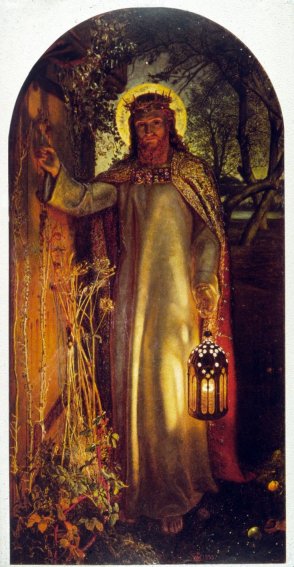
A. I wonder if you have ever seen the famous painting by Holman Hunt of Christ the King knocking on a door holding a lantern in his hand? The original is in my home city of Oxford so I know it rather well. He is on the outside waiting for it to be opened from within. But this door is unlikely to be opened until Yah'shua (Jesus's) Ruach (Spirit) penetrates the soul of the householder.
I am reminded of the wind. When it's really windy it comes through every crack in the house! Open the door or a window and it floods in. Luckily for us there are lots of cracks in our armour to keep Elohim (God) out so He penetrates in many ways in little degrees. These little penetrations are most important to the overall goal of getting us to open the door and admit Him fully.
The full glory of Elohim (God) is not only that He knocks from without but that He also enlightens us and persuades us from within. Unfortunately many Christians/Messianics confuse the two, mistaking the act of persuasion with the grand act of redemption.
Yahweh's persuasion precedes all our responses, and persists with unabated invitation (Gal.1:15; Jn.1:16; 2 Pet.1:2-3).
Every house has a leak. I know mine has because every winter the mice get in. When I seal one entrance they always find another. I've decided to built my next home like an air-lock!
No human armour can keep Elohim (God) out 100 per cent, thank goodness. You can try, but you won't manage completely. For a Christian/Messianic wanting to deny the emet (truth) it's even harder because there are already windows open.
David understood this all too well, saying:
"Whither shall I flee from Thy Ruach (Spirit)? or whither shall I flee from Thy presence? If I ascend up into heaven, Thou art there; if I make my home in hell, Thou art there.." (Ps.139:7-12, KJV).
I said the navi (prophet) can't get away. Nor can the man or woman who has opened his heart to Yah'shua (Jesus) and tries to run away. He might put up good defenses for a long time but in the end they will crumble.
Elohim (God) takes the initiative, but takes His own time and awaits His own occasions.
Take Isaiah's revelation (Isa.6:1). Not until righteous Uzziah died and Isaiah felt his loss deeply did he sense His need for Elohim (God). Deep loss and tragedy often open us up to the Ruach Elohim (Spirit of God).
Peter, James and John were not given their transfiguration experience until the appropriate time had arrived (Mt.17:1-8). It would have been meaningless to them if it had occurred earlier.
Yah'shua (Jesus) had much He wanted to teach the 12 Apostles but they had to wait until He was dead and resurrected so that the ministry of the Ruach haQodesh (Holy Spirit) could teach them things from the invisible world.
Q. I wonder if you could summarise for us your main message on revelation?
A. REVELATION IS NEVER COMPLETE. IT IS GEARED TO OUR CAPACITY AND CONCERN. AND IT ALWAYS PROMISES MORE THAN IT GIVES.
These three are vitally important to understand. Every navi (prophet) discovers it and so does every other man and woman in Messiah. The young rarely do. They must wait for their 'better years'.
You see, even though a man who has had an experience with Elohim (God) should use the same words to express that experience as he did 10 years ago, nevertheless - if he has lived with his experience - he now puts more meaning into the words he uses than he ever did before. Take a look at Acts 11:16 and compare it with Acts 15:6-11 and you will see that Peter 'remembers' in the light of his intervening experience.
Q. I know people hearing this will feel impatient and rebellious when it seems that Elohim (God) is not revealing Himself. What should they do?
A. Your question contains its own answer. Patience. These people must also remember that to stand in Elohim's (God's) presence in our sins would overwhelm us and all the meaning we had gained from our spiritual growth up to that time would be lost. Think back to the time when the Cohenim (Priests) could not minister at the Temple because Elohim's (God's) presence was so strong (1 Ki.8:11 cp Mal.3:2). In hiding Himself, Yahweh is merciful.
By this key I am usually able to discern who is, and who is not, a navi (prophet). The self-acclaimed and self-promoting nevi'im (prophets) want to 'tell all' indiscriminately, calling people to repentance by exposing all their sins before they have acquired the capacity to deal with them, and revealing evry mystery he knows. The true navi (prophet) must sense what can be done with each individual at any one moment of time.
Instead of getting impatient and complaining what we should do is to improve the quality of our seeking. We must search for Elohim (God) as we are commanded to love Him - involving our whole "heart, mind, and strength" (Mark 12:35). Too much prayer is half-hearted and insincere. The fast food generation want everything fast, at a special offer, and preferably free. That's the worst possible kind of attitude to bring to the Besorah (Gospel). Those who do not get things easy are usually those who find their ways to the throne of Elohim (God) quickly. Yah'shua (Jesus) said that it was nearly impossible for the rich to get into heaven, and no wonder. Life is too easy for them - to relaxed and laid-back.
Once we have understood a matter we must be transformed by it. Failure to repent, not just failure to think, leads to loss of Light. So if someone is feeling impatient and rebellious then I have only one thing to say to them: Repent! Stop thinking and get on with living the Besorah (Gospel). Your time will come - wait patiently for it and in the meantime do everything you can with the knowledge you have.
So I leave you Paul's challenge:
"But now that you know Elohim (God) - or should I say, now that Elohim (God) knows you, how is it that you want to turn back to those weak and pitiful ruling spirits? Why do you want to become their slaves all over again...I am worried about you!.." (Gal.4:9,11a, GNB).
I worry for the people who want to rush into the world of revelation for they do not know what they want. I remember one young lady who came to us because she wanted to be a prophetess. She was soon gone with her tail between her legs when she saw the price she would have to pay. She wanted something for nothing, and something Elohim (God) had not specifically called her to. Beware.
Every man needs to know Elohim (God) for himself and this knowledge will grow in him as he diligently seeks Him (Heb.11:6). He also needs the companionship which assures him that he is not following cunningly devised fables (2 Pet.1:16). Where will he find this companionship? In the testimony of men of like devotion and parallel experience.
Q. In other words, in the Messianic Community (Church)!
A. In the Community of believers, yes. If you want to understand revelation then go to a fellowship of revelation. And if you want to experience true revelation, then you must go to a fellowship that is being true.
Q. And where is that?
A. Where there is a beautiful garden full of luscious spiritual fruits and people who are eating and sharing them.

This page was created on 26 February 1997
Last updated on 15 May 2017

Copyright © 1997-2017 NCAY - All Rights Reserved