
1-5. Conclusion
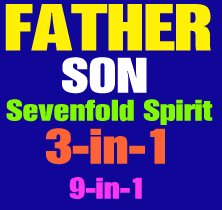
How can all these facts be brought together? Not by postulating three Gods (Mormonism), since the Bible is emphatically monotheistic from cover-to-cover. Not as a single Elohim (God) playing three parts or rôles at different times (Dynamic Modalism, Sabellianism or Monarchism).
The only summary that meets all the scriptural statements is three Persons in one Elohim (God). Elohim (God) is echad (one), but this oneness is not a bare mathematical unity. It involves personal relationship. Even in ourselves we are aware of some shadow of this higher unity. We are one, and yet we are personal in our body, personal in our mind, and personal in our heart. My body, mind and heart are all involved in one another, but there are certain things that my mind does (thinking), certain things my heart does (feeling), and certain things my body does (e.g. eating).
Explaining on a human level how all this happens is not easy, for the lesser (man) is trying to explain the greater (Elohim/God). Classical Trinitarians would claim that it is proper to say that the second Person in the Trinity, and not the Father, became man, and His incarnation did not break the Trinity, although this fails to take into account the fact that Isaiah refers to the Son as the 'eternal Father'. Nevertheless, while classical Trinitarianism fails to take every scripture into account, it is by no means an unreasonable postulate, and those who reject it as ridiculous should be reminded that three-dimensional space is a natural analogy of what could be said about the Trinity. Space requires length, breadth and height. All three are equal in importance, and none is greater than the others. So we have three dimensions forming one space. For some purposes we treat them as one; for other purposes we separate them.
Neat though such a postulate is, the 3D space analogy is of limited value given the fact that scripture teaches both co-equality of the three members of the Elohim/Godhead and the subordination of the Son to the Father, and of the Ruach haQodesh (Holy Spirit) to the Father and the Son.
It is wise, therefore, to avoid dogmatism and leave the Elohim/Godhead doctrine open. Though we cannot finally say what the Elohim/Godhead is in the ultimate sense, we can certainly say what it is not - polytheism, unitarianism, Arianism, Sabellianism, etc. - and that, surely, is a major step in the right direction for anyone seeking to be true to the biblical revelation.
We hope that this brief summary of the NCAY position on the Elohim/Godhead has been helpful before you investigate our other teachings. Because the Elohim/Godhead question is so central to a Christian/Messianic Comnmunity's theology as a whole it is certain to spill into other areas of belief and practice. Indeed, the nature of the Ruach haQodesh (Holy Spirit) is a key element in the Messianic Community's (Church's) teaching about women's ministry which you will find explained in detail in other articles.
May the Triune Elohim (God) - Father, Son and Seven-Fold Ruach haQodesh (Holy Spirit) - bless you as you search to understand and implement the emet (truth) in your life. Amen.
Some Articles on This Site Reflecting Different Godhead Views
a. Classical Trinitarianism:
 A Defence of the Trinity Doctrine as Seen Through the Old Testament
b. Messianic Evangelical/New Covenant Christian Proto-Trinitarianism:
THE ELOHIM/GODHEAD: A Complete List of Elohimhead Articles & FAQ
Yah'shua the Messiah and His Place in the Elohim/Godhead 
Proto-Trinitarianism: The Elohim/Godhead Doctrine of NCAY
Filioque: A Controversy that Illuminates the Elohim/Godhead
The Minimum Elohim/Godhead Doctrine
Will Yahshua (Jesus)
Always Reign Over Us?
'Father', 'Lord' and 'God':
What is the Difference?
The Trinity: What's the Messianic Evangelical Position?
The Word Made Flesh - series
c: Anti-Trinitarianism
Trinitarian Dogma: The Very "MYSTERY BABYLON" of Revelation 17:5!


This page was created on 18 July 1999
Last updated on 16 February 2017
Copyright © 1987-2017 NCAY - All Rights Reserved