which means something completely different today than it did when the KJV was written half a millennium ago, so does the modern word 'grace'. The meaning and usage of words change and evolve. 'Lust' back in 1611 did not mean a sexually perverse spirit but to eagerly desire something, good or evil. Thus in King James' day you could lust after the flesh or lust after the Spirit (Ruach). How can we "grow in grace, and in the knowledge of our Master (Lord) and Deliverer (Saviour) Yah'shua the Messiah", as Yah'shua did and as we are commanded to (2 Pet.3:18) if we're not sure what it means?
Did Yah'shua Grow in Grace or Favour?
You may have noticed that when I quoted the ISRV messianic version the translating committee opted to use the word "favour" instead of "grace":
"For sin shall not rule over you, for you are not under the law but under favour" (ISRV).
The scriptures say that Yah'shua grew in charis (Lk.2:52). The word charis here is translated "favour" in the KJV. Many marginal notes show "grace" as the alternative translation. If charis is exclusively 'unmerited pardon' as some have believed, how could Yah'shua, who never sinned, grow in unmerited pardon? And especially how could He grow in unmerited pardon with man when He never sinned against any man? The translation here (Lk.2:52) of "favour" is obviously the correct one. It is easy to understand that Yah'shua grew in favour with Yahweh and man. In Luke 4:22 the people were amazed at the gracious ('favourable to men') words which proceeded out of Yah'shua's mouth. Here the Greek word for gracious is also charis.
Favour and Grace are Not the Same
In Acts 2:46-47 we find the disciples "...having charis with all the people" (KJV). In Acts 7:10 we find Yahweh gave our forefather Joseph charis in the sight of Pharaoh. The King James Version Bible has translated charis as "favour" here. In other places we find charis translated "favour" too (Ac.25:3, Luke 1:30; :46) because favour is the obvious meaning.
Why not Favour?
It is not totally clear why some do not like the definition of favour for grace. However, it does have the implication that it does not matter what you do once you have accepted Yah'shua the Messiah as your Saviour, and that I suspect is the attraction for some Christians. Many believers know that it does matter what Christians do! We must keep the commandments. We know that "[Elohim gives his Ruach] to those who obey Him" (Ac.5:32). So how does "favour" fit into the equation?
Grace is Favour
In Webster's 1994 Encyclopedic Unabridged Dictionary, the third definition of grace is "favour". Under the theological definition, "unmerited favour" is found. Unmerited favour implies that there also can be favour that is merited too. Obviously. Therefore there is the favour which we don't deserve and can't be earned, and there is the favour which we deserve because we have earned it by our deeds. Is it not therefore more logical to render charis as "favour" rather than "grace", as the ISRV does, in this context?
Why Do We Receive Yahweh's Favour?
The misunderstood part of the 'grace versus works' argument is that man receives Yahweh's favour (grace) for two different reasons. First, Yah'shua died for us while we were yet sinners (Rom.5:8). Most all of Christendom would agree that this is Yahweh's "grace" - His undeserved loving kindness or unmerited favour:
"For Elohim so loved the world that He gave his only begotten son, that whosoever believes on him might not perish but have everlasting life" (John 3:16).
This is the first part of the salvation process, that we are cleared of the death penalty over us assigned because of breach of Torah which previously we had resolved under the Old Covenant by a temporary covering through the Mosaic sacrificial system. A Christian is justified (has his past sins paid for) by Messiah's death as the Lamb of Elohim. There is nothing we as Christians can do to pay for our sins except die or accept Yah'shua's death for us. Man was favoured by Yahweh with this redemption! Why?! Why was man favoured (graced) with our past sins being paid?
Reason #1: Why Favour to Man?
Yahweh did not favour with salvation the angels who sinned! Yahweh did not offer angels sonship (Heb.1:5; 2:6-10). Yahweh favoured man because we are made in His image. Awesome is the favour we have received! The offspring of any being looks like the father in kind, does it not?
"...we are the offspring of Elohim" (Ac.17:26, 28-29, KJV).
"Behold what manner of love the Father hath bestowed on us, that we should be called the sons of Elohim" (1 Jn.3:1, KJV).
Those who do not believe that man is made in Yahweh-Elohim's image cannot even understand why we receive charis (grace) for our justification.
Reason #2: Growing in Favour (Grace)
The other reason we receive Yahweh's favour (grace) solves the 'grace versus works' dilemma. How does one grow in favour with any boss? By keeping his directives or commands! Once we have believed in Yah'shua's sacrifice to pay for our sins (breaking the Torah or Yahweh's commandments), and once we have repented (started keeping the commandments) and are baptised, we receive the Ruach haQodesh (Holy Spirit). We are now the children of Elohim (in a sort of begettal state) by the indwelling of the Ruach. We have Yahweh's seed in us (1 Jn.3:1-2,9). Now we have grown in (grace) favour in Yahweh's eyes!
So the second reason we receive grace (favour) is because we have the Ruach haQodesh in us leading us to keep the commandments (mitzvot) in their spirit and intent (1 Pet.1:22). As we learn to better keep the commandments, we can receive more of Yahweh's precious Ruach (Eph.5:18). Notice Stephen was full of the Ruach haQodesh near the end of his life (Ac.7:55, 60). We grow in favour with Yahweh by maturing in the keeping of the commandments!
Not under the Law, but under Favour
Satan, the god of confusion, would certainly not want us to fully understand this very important issue! (Job 1:6, 1 Cor.14:33, 1 Thess.2:18). So he has caused the modern word "grace" to be so used in religious circles that it has become ethereal and unreal. He would have us believe 'it is too wonderful to be understood'. He would have us believe that being saved by grace alone means we don't have to keep the commandments any more but be led by our fickle feelings or heart only.
We Make Mistakes
Christians are not perfect. They may make a mistake and sin! They may not keep the Bible Sabbath perfectly every week. But they are not openly working on God's Sabbath days. They are not sinners in the sense of being dead in sin, like working on Sabbath and keeping another day of the week and thinking they are serving Yahweh. Under the Old Covenant Torah each sin required an animal's death in sacrifice (Num.15:27-28; Lev.4:13,20,22,26-27,31,35; Lev.19:22). Under favour (grace) repentance of the sin is required and looking to Messiah (Hebrews 10:10-11, 21; 1 John 2:1-4). It means constant washing by the water of the Word.
Called to be Perfect Under Grace
True Christians are under great favour from Yahweh but are simultaneously called to be perfect. Yahweh watches over us as any good father watches over his children and favours them (1 Pet.3:12; 5:10-12; Mt.5:48; 1 Jn.3:10). He even favours them with chastening when needed (Heb.12:6; Rev.3:19). If you are a father you know this to be true. You continue loving your children no matter what they do - you extend unmerited favour or grace to them. But at the same time there is conditional favour too - you favour those who do what is good and right but do not show favour to those who are constantly in rebellion. Thus Yahweh could say:
Jacob and Esau
"'Was not Esau Jacob's brother?' says Yahweh. 'Yet Jacob I have loved; but Esau I have hated, and laid waste his mountains and his heritage for the jackals of the wilderness" (Mal.1:2-3, NKJV).
Such passages are only confusing to those trapped in wrong thinking. Does this mean that Yahweh had no heart-love for Esau? Not at all. Yahweh loves everyone - he shows all people unmerited grace by offering His Son in atonement, just as a true father loves all of his children. So how could He "hate" Esau yet "love" Jacob" at the same time? This was his response to their works - and what did Esau do?
"So Esau hated Jacob because of the blessing with which his father blessed him" (Gen.27:4, NKJV).
When Yahweh Shows Merited Favour and When He Does Not
Yahweh cannot ever favour someone who hates another person. Therefore Yahweh favoured ("loved") Jacob and disfavoured ("hated") Esau. We may not hate a person though we may hold them in disfavour - we are permitted to only hate sin.
This means - put bluntly - that Jacob was his 'favourite' and He blessed him accordingly. However, this was not a favour based on the biases of the human flesh but upon perfect divine judgment. Yahweh did not, however, overlook Jacob's faults either, but continually refined him until at the River Jabokk he finally became an overcomer and earned the name of Israel. We must do no less.
Isaac favoured Esau, we presume, because he served his father's stomach so well, yet Jacob was the spiritual boy who deserved his father's favour. Esau was his father's 'favourite' and wrongly so, a favouritism which led to tragedy as we know. As both Christians and parents we are to show both unmerited favour for love's sake - and specifically the the sake of the love expressed for us on the Cross - as well as merited favour based on good works. Don't we reward our children when they do well, and withhold rewards when they do not, punishing them when they do evil? Of course we do, just as Yahweh does. That does not mean that we stop loving them or that we reject them when they do wrong - we still extend grace and undeserved loving kindness to them, as Yahweh does to us. They still remain our sons and daughters.
The Impartiality of Yahweh
Modern translations confuse the issue by mixings words. Therefore the New King James Version would have us believe that "God shows personal favouritism to no man" (Gal.2:6, NKJV) whereas a better translation would be:
"God shows no partiality" (NASB)
"Elohim shows no partiality" (ISRV)
The context is people who thought they were important, for Yahweh accepts no man's "person" (KJV, RSTNE):
"Moreover, those who were the acknowledged leaders - what they were makes no difference to me; God does not judge by outward appearances..." (JNT).
So we must be careful with English translations and double check them - that is why we recommend our people to have multiple translations and reliable lexicons. Yahweh shows no favouritism or partiality based on human judgments. He loves us unconditionally as sons and daughters but He shows little or no favour to law-breakers. On the contrary, He punishes them.
Faith and Works United
The harmony between faith and works, which the apostle James so clearly explained 13, is therefore understood of Paul too. There was no conflict between the two writers as Martin Luther believed 14 and many modern Messianics believe today. We can do absolutely nothing to earn the grace (unmerited favour or undeserved loving kindness) bestowed by the atonement of Messiah but we absolutely can, and do, earn Yahweh's favour by obedience to the commandments. Even then that 'deserved favour' is a kind of grace (undeserved favour) because we are empowered to obey only by the indwelling of the Ruach haQodesh - in our own selves we are incapable of generating righteousness:
"But we are all like an unclean thing, and all our righteousnesses are like filthy rags" (Isa.64:6, NKJV).
A Matter of Choosing Obedience or Rebellion
But it would be wrong to think of this as totally passive on our part - we still have the choice to be obedient or rebellious, and to exert an effort. We can trust Yahweh or not in choosing obedience or rebellion. And if we make the choice to be obedient, doing as we are told, then we are empowered to walk in that favour. The difference between those who believe only in grace and those who believe in grace and favour is the difference between the first and second resurrections, being willing to endure all things for our Master, as I have told you so many times. And personally I do not think that is a little thing. Therefore let us therefore keep Yahweh's commandments - all of them - and stay in his favour.
The Period Between Sukkot and Pesach
What does this have to do with the 'inter-festival' period I spoke of at the beginning? Everything. The period between Sukkot and Pesach is the invisible 'grace' period when we don't have to 'do' anything (festival-wise - obviously Shabbat or Sabbath and Rosh Chodesh or the New Moon continue to roll around each week and month, respectively) and the period between Pesach (or arguably the New Year a few days before) and Sukkot when we are commanded to assemble and 'do' many things. In a very loose sort of way the non-Festival Period is for those 'under grace' who are born again, trusting in Yah'shua, and heirs to the general resurrection of salvation (i.e. Evangelicals), and the Festival Period is for those Evangelicals who are under Yahweh's Favour as obedient disciples or talmidim of Torah - who guard the commandments (mitzvot) and do them diligently under Yahweh's Grace. It's what makes them 'Messianic Evangelicals'. It follows that you cannot be a Messianic and be saved without first being an Evangelical.
Understanding the Earthly and Heavenly Menorah
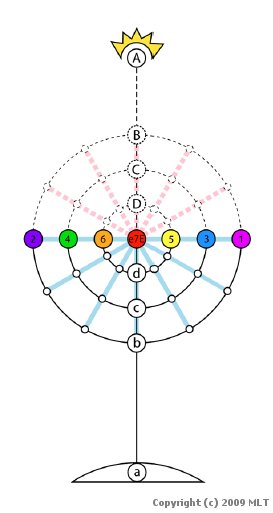
If you look at the diagram of the dual earthly and heavenly Menorah I showed you at the beginning you will notice something very interesting, namely that there are seven solid 'beams' or 'rays' that proceed horizontally and downwards out of the central pillar coloured pale blue and five broken 'beams' or 'rays' that proceed vertically out of the central pillar coloured pink. Together they make a total of twelve 'beams' or 'rays'. The pink beams represent Yahweh's Grace or Unmerited Favour which there is abolutely nothing we can 'do' to merit them other than to adhere to Yah'shua and endure He remains IN us through trusting Him. Five is the number of Grace as traditionally understood by Protestants. The pale blue beams represent Yahweh's favour toward us - His approval of us - which we earn by our obedience to Torah and specifically observation of the Kashrut laws 15, Festivals 16, Sabbaths 17 and New Moons 18. The latter are manifested in the earthly and visible sphere, just as the Menorah was, whereas the former are largely invisible.
Conclusion
Today we have learned that there are two kinds of grace - the undeserved favour of Yahweh which we can never earn that comes from trusting Yah'shua for our salvation - and the merited favour which comes from obedience to our Heavenly Father's laws or Torah. We cannot ever earn the resurrection of the saved but we can, through our choice to be obedient or not, determine whether we inherit the first or second resurrections. We have seen that obedience is also a function of grace inasmuch as we are incapable of full obedience without the presence of the Ruach haQodesh empowering us to live the way Yahweh wants us to - the Torah lifestyle. We have also learned that Paul was not against Torah but against legalism or the attempt to earn salvation. It is never a question of Grace vs. Law but of Grace-&-Torah-Obedience vs. Legalism.
We will be developing this important subject in the next few weeks including taking a hard look at Yahweh's Gifts. We are going to ask ourself exactly what a Divine Gift is, and especially how salvation is a 'gift' and what the relationship between a gift and obedience to Torah is. As we enter the 'quiet time' between the end of one cycle of festivals and the beginning of the next, let us use these months to focus on what Grace really is and respond obediently to His commandments in such a way that we may walk in Yahweh's continual favour and blessings. Baruch haShem Yahweh! Amen.
Click here for Part 2
Acknowledgements
[1] Bill Hillebrenner, The Plainer Truth about Grace
Endnotes
1
MLT does not observe Hanukkah or Purim which were added later without divine mandate (the first at the insistence of the Pharisees and second under the initiation of Queen Esther) and appear during this six month period in the Talmudic calendar.
2
See Hanukkah
3
See Purim
4
See, for example, The Triumph of Grace and the Will to Surrender and Messianic Evangelicals
5
The Scriptures (Institute for Scripture Research, North Riding, South Africa: 2000), p.1091, footnote #l.
6
David Stern, Jewish New Testament Commentary (Jewish new Testament Publications, Clarksville, Maryland: 1992), pp.552-3
7
David Stern Messianic Jewish Manifesto (JNT Publications, Jerusalem, Israel: 1988), Chapter 5, pp.125-187
8
C.E.B.Cranfield, Romans (International Critical Commentary, Edinburgh, T&T Clark: 1981), Vol.2, p.853
9
See Messianic Heresies Exposed
10
A Hebrew primacist believes that the New Testament was orginally written in Henrew or Aramaic (with perhaps one or two exceptions) and that when there are conflicts in translation, deferral should in most cases be given to the Hebraic text.
11
Strong's Concordance #G5485
12
For example, "gay clothing" (Jas.2:3, KJV) does not mean homosexual attire.
13
"What does it profit, my brethren, if someone says he has faith but does not have works? Can faith save him? If a brother or sister is naked and destitute of daily food, and one of you says to them, 'Depart in peace, be warmed and filled,' but you do not give them the things which are needed for the body, what does it profit? Thus also faith by itself, if it does not have works, is dead. But someone will say, 'You have faith, and I have works.' Show me your faith without your works, and I will show you my faith by my works. You believe that there is one Elohim. You do well. Even the demons believe -- and tremble! But do you want to know, O foolish man, that faith without works is dead? Was not Abraham our father justified by works when he offered Isaac his son on the altar? Do you see that faith was working together with his works, and by works faith was made perfect? And the Scripture was fulfilled which says, 'Abraham believed God, and it was accounted to him for righteousness.' And he was called the friend of Elohim. You see then that a man is justified by works, and not by faith only. Likewise, was not Rahab the harlot also justified by works when she received the messengers and sent them out another way? For as the body without the spirit is dead, so faith without works is dead also" (James 2:14-26, NKJV).
14
Luther dismissed the Letter of James as a mere "straw gospel" and sought (unsuccessfully) to have it removed from the Bible canon.
15
See Kashrut
16
See Festivals
17
See Sabbath
18
See Rosh Chodesh
Author: Lev-Tsiyon
Comments from Readers
[1] "Shalom Bro. Christopher. It is [a] very interesting subject you explained in your Episode (V024), Amazing Graces and Free Gifts
. I appreciate the way you present the subject. Thank you. Shalom" (SR, India, 1 July 2018)


This page was first created on 16 October 2009
Last updated on 1 July 2018
 Copyright ©2009 Mishpachah Lev-Tsiyon (MLT) - All Rights Reserved