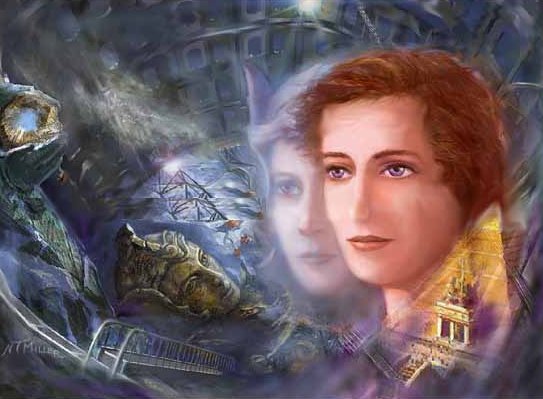
Reincarnation, also known as Transmigration and Metempsychosis, has become one of the most popular beliefs in the West with many Christians even accepting the doctrine.
The Claims of Hinduism
According to Hinduism, the eternal soul or atman is a manifestation or 'spark' of the god Brahman that is mysteriously trapped in the physical body. Samsara, repeated lives or reincarnations that take place throughout long cycles of evolution, are required before the soul can be liberated (moksha) from the body. An individual's present life, according to Hindu doctrine, is determined by the law of karma which are the words, actions and thoughts in previous lifetimes. The physical body is ultimately an illusion (maya) with little inherent or permanent value. Bodies are generally cremated, and the eternal soul is parked in an intermediary state of punishment or reward before birth in another body as either another human, animal or even a plant of the karma is particularly bad. Rebirths continue to be experienced until karma has been removed to allow the soul's re-absorption into Brahman leading to the effective extinction as an individual.
Who benefits from this arrangement, and how, is never explained, since in the Hindu system human extinction as individuals is apparently the goal, with Brahman somehow benefitting from these endless cycles of human misery. There is no individual reward as such, the only motivation being to end the torture of separate existence as though individuality itself were a bad thing.
The Bible, in stark contrast, teaches a different reality. Men and women are created in Yahweh's image (Gen.1:27) with a very different kind of union with Elohim (God) known as Echad (oneness) in mind - one of joyful relationship between the Creator and the created both in mortality and in a future state of immortality. Accordingly, the body's physical resurrection and eternal worth are emphasised:
"So the Judeans (Jews) answered and said to Him, 'What sign do You show to us, since You do these things?' Yah'shua (Jesus) answered and said to them, 'Destroy this temple, and in three days I will raise it up.' Then the Judeans (Jews) said, 'It has taken forty-six years to build this temple, and will You raise it up in three days?' But He was speaking of the temple of His [physical] body. Therefore, when He had risen from the dead, His talmidim (disciples) remembered that He had said this to them; and they believed the Scripture and the word which Yah'shua (Jesus) had said" (John 2:18-22, NKJV).
For a fuller exposition, see 1 Corinthians 15.
The Bible further declares:
"And as it is appointed for men to die once (not many times), but after this the judgment, so Christ was offered once to bear the sins of many. To those who eagerly wait for Him He will appear a second time, apart from sin, for salvation" (Heb.9:27-28, NKJV).
Since we die only once, reincarnation cannot therefore be true, and instead of reincarnation (that is taught by most Eastern religions which has, since the second half of the 20th century, been incorporated into a number of recent Western imitations), the Bible teaches resurrection (Jn.5:25). At death, Christians enjoy a state of conscious fellowship with Christ as disembodied spirits (Mt.22:32; 2 Cor.5:8; Phil.1:23) to await the physical resurrection and rewards back on a glorified earth. A person's eternal destiny is determined by his or her acceptance or rejection of Yah'shua the Messiah (Jesus Christ) as Saviour (Deliverer) and Master (Lord) (Jn.3:36; Rom.10:9-10).
The Claims of Buddhism
Buddhism has a similar though more simplified belief system (including reincarnation) to Hinduism which it broke away from. Whereas Hinduism has incorporated Yah'shua (Jesus) into its pantheon of millions of gods (once Christianity was introduced to India by Europeans), no such polytheistic pantheon exists in Buddhism. Most Buddhists regard Yah'shua (Jesus) as an 'Enlightened Master' though definitely not the Son of Elohim (God) as Buddhism achnowledges no God at all.
The leader of Tibetan Buddhism, the Dalai Lama, and representative of the Mahayana School of Buddism, regards Yah'shua (Jesus) as a fully 'enlightened being' like that of Buddhism's founder, an Indian Prince named Siddhartha Gautama, though other Buddhist groups, such as Soka gakkai Nichiren Buddhism in Japan, consider Him to be a Boddhisatva, on the second tier of enlightenment below Buddahood which Buddhists claim Gautama himself attained. For the founder of this website's personal supernatural experience with these claims, see A Glimpse into Heaven: My Life Story and How I Came to Know Yah'shua the Messiah (Jesus Christ)
In an article in Christianity Today, the interviewer challenged the Dalai Lama with this thought:
"If Jesus (Yah'shua) is fully enlightened, wouldn't He be teaching the truth about Himself? Therefore, if He is teaching the truth, then He is the Son of God (Elohim), and there is a God (Elohim), and Jesus (Yah'shua) is the Saviour. If He is fully enlightened, He should teach the truth. If He is not teaching the truth, He is not that enlightened."
The Dalai Lama claimed that Yah'shua (Jesus) had lived many previous lives and that His sole mission was to teach a message of tolerance and compassion, to help men and women to become better human beings. Needless to say this was not only thing the Saviour taught, one of His teachings being to specifically repudiate the pagan doctrine of reincarnation on at least two separate occasions:
"When Yah'shua (Jesus) came to the region of Caesarea Philippi, He asked His talmidim (disciples), 'Who do people say the Son of Man is?' They replied, 'Some say John the Baptist; others say Elijah; and still others, Jeremiah or one of the nevi'im (prophets).' 'But what about you?' He asked. 'Who do you say I am?' Simon Peter answered, 'You are the Christ, the Son of the living Elohim (God)'" (Mt.16:13-16, NIV).
Here the Messiah teaches that He comes in the spirit of Elijah as an Elijah Prophet, as Malachi prophesied (Mal.3:23) and not as the reincarnated Elijah. Yah'shua (Jesus) made the same claim of John the Baptist, the navi (prophet) whose mission was that of a forerunner of Christ (Mt.11:14). Also:
"As He (Yah'shua/Jesus) went along, He saw a man blind from birth. His talmidim (disciples) asked Him, 'Rabbi, who sinned, this man (implying a previous existence in which he sinned) or his parents, that he was born blind?' 'Neither this man nor his parents sinned,' said Yah'shua (Jesus), 'but this happened so that the work of Elohim (God) might be displayed in his life. As long as it is day, we must do the work of Him (Heavenly Father, Yahweh) who sent Me. Night is coming, when no one can work. While I am in the world, I am the light of the world" (John 9:1-5, NIV).
Elsewhere in Scripture human beings are likened to "a passing breeze that does not return [to mortality]" (Ps.78:39, NIV) and states that "the day of Yahweh is near for all nations. As you have done, it will be done to you; your deeds will return upon your own head" (Obadiah 1:15, NIV). You cannot postpone Judgment to another imaginary life.
Summary
Hinduism claims that salvation (liberation) is achieved when a person transcends this world of illusion by building up enough positive karma (good works) to escape the cycle of reincarnation. Buddhism claims that salvation (nirvana) is the result of detatching one's self from the desires of the physical, material world and by this means likewise escape the cycle of reincarnation. In both systems, the soul loses its identity and is absorbed back into one of millions of Hindu gods (Brahman) or into a collective spiritual mass (Nirvana) not unlike the 'force' in the Star Wars science fiction movies.
The teaching of reincarnation seems to hold a special attraction for people who are discontented with the present life to one degree or another and who hope to get 'another go'. It also satisfies a deep perceived romantic need to suppose in a past life one might have been important - a great religious or military leader, royalty (a prince or princess) or even a powerful creature like a lion or an eagle. Significantly, it builds on the false idea that the soul is somehow pure and the body defiled or even evil, notions common to ancient and modern gnosticism and to the heretical 'Prosperity Movement'. Accordingly, proponents of reincarnation are often found to denigrate sex and promote (strangely enough) both ascetic and anti-Torah libertine practices (e.g. Nicolaitianism - Rev.2:6,15).
One of the most spiritualy harmful aspects of embracing a belief in reincarnation is that it diminishes responsibility for personal actions, a consequence of which is that one no longer takes sin seriously. This spiritual laziness results in the false belief that the sinner can make up for his transgressions in the present life in the next one, or any number of lives after that. It also assumes a certain fatalism because it rests on the assumption that everyone will eventually achieve liberation from the 'wheel of karma', an idea running in parallel with another false assumption made by the Christian sect of Calvinists, namely, that we are predestined to salvation or damnation no matter what we do. In other words, believers in reincarnation dismiss the idea of a Day of Judgment when sinners must give an account to Yahweh for their actions and receive what their deeds deserve. Hence a lack of motivation for ethical behaviour. This attitude also provides a pretext for the dangerous belief that people often excuse their present sins as an outworking of the karma of their past lives - 'my karma made me do it, I'm not responsible'.
There is another dangerous consequence to a belief in reincarnation:
"Reincarnation also does away with the idea of historical purpose. This is because it implies that the individual soul's journey from body to body is incomparibly more important than anything a nation or a people might do. I call this the yo-yo theory of history: it asserts that the soul descends from the eternal unchanging world, takes on a body and appears in this illusory world of ordinary existence where nothing matters, lives a life without significance in relation to other people, and then goes back up into the eternal unchanging world, only to repeat the process. This yo-yo theory of history, in which nothing of moment ever happens, completely contradicts the Tanakh's (Old Testament's) pervasive theme that history has a beginning (creation), a middle (revelation) and an end (redemption) - that God (Elohim) created man for a purpose, and has revealed His choice of a people, Israel, through whom He will accomplish that redemptive purpose" [1].
Biblical Christianity proclaims human beings have but one physical existence, and that salvation comes by the grace (undeserved loving-kindness) of Yahweh, our Heavenly Father, through faith (actively trusting) in Yah'shua the Messiah (Jesus Christ) His Son, and is demonstrated to have taken place through obedience to Yahweh's Torah commandments or way of life revealed or manifested in the good works of the saved.
To learn more about the deception of 'reincarnation' which has infiltrated many religious systems apart from Hinduism and Buddhism like (unbiblical) New Age 'Christianity', see the materials in the register below.
Endnotes
[1] David H. Stern, Jewish New Testament Commentary (JNT Publications Inc., Clarksville, Maryland: 1992), p.701
(22 December 2025)
|