RESOURCES
5-144000
A
B
C
D
E
F
G
H
I
J
K
L
M
N
O
P
Q
R
S
T
U
V
W
Y
Z
|
|


You may have heard of atheist Eben Alexander III (born 11 December 1953), an American neurosurgeon and author of the book, Proof of Heaven: A Neurosurgeon's Journey into the Afterlife (2012) who had a Near Death Experience (NDE) in 2008 when under a medically-induced coma whilst being treated for bacterial meningitis in a Lynchburg hospital. In doing so, he gambled with his professional reputation. What makes his case interesting is that he was pronounced clinically brain-dead so 'couldn't' have been having the thoughts he did (according to the naturalistic and atheistic view of the universe which denies a consciousness independent of the physical body). His entire neocortex - the outer surface of the brain - was completely shut-down, inoperative. Scientists stuck in the Darwinian paradigm have been unable to explain his experience, and accordingly have given very unsatisfactory 'explanations'.
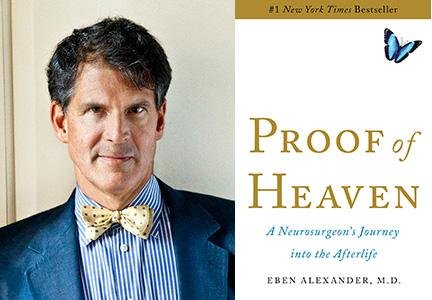
Stories of Near Death Experiences (NDEs) that commonly reveal a bright light leading to a compassionate world are as old as time and are being published with increasing frequency as men and women of all religious - and even non-religious - persuasions are experiencing life 'on the other side' and coming back to tell the tale.
Are these experiences genuine? And if they are, why do they paint such different pictures of the after-life? How should a Christian/Messianic deal with such accounts? What is the difference between a staged, theatrical demonic counterfeit and Yahweh actually adapting a person to their own life or cultural experience and mindset in order to help them process and understand the spiritual dimension when they have an authentic out-of-body experience? Find out on this page.
If you want to know more about these things and discuss them (some of us have had direct experience of such things), contact us or join in one of our online discussion groups.
|
Key: Art=Article | FAQ=Frequently Asked Question | Sc=Science | St=Sermonette | Occ=Occult | OB=Olive Branch | PCM=Patriarchal Christian Marriage | NCCM=New Covenant Christian Ministries | Sab=Sabbath | Sal=Salvation | 5Com=Five Commissions | AI=Apostolic Interviews

"And as it is appointed unto men once to die, but after this the judgment" (Heb.9:27, KJV).
An objection to all and every kind of NDE being a real representation of life after death is this Scripture from the King James Version. Does this mean that we die but once and can therefore never return save at the final resurrection?
It is the view of this ministry that many, NDEs are counterfeit and orchestrated by the demonic when a person is out of his of her body. Given that reincarnation was widely believed in by many superstitious Jews exposed to pagan religion in first century Palestine, it seems the author of Hebrews may have had this false idea in mind. The talmidim (disciples) even entertained reincarnation as one possible explanation for a blind man's unfortunate condition and asked the Saviour, "Rabbi, who sinned, this man or his parents, that he was born blind?" (John 9:2, NIV) and were told neither were. But is reincarnation in mind in Hebrews 9:27? It seems highly likely.
Very clearly there are people who physically die and are resussitated after longer or shorter periods of time. The account of Lazarus is all the more remarkable as he had been dead for many days, long enough for his body to start decomposing and smelling badly (John 11). Clearly Lazarus died and returned to live a normal life until dying finally at the end of his life. Technically, then, because Yah'shua (Jesus) resuscitated Him and healed his decomposing body, he was not 'finally dead'. His raising was not a resurrection, which would have made him immortal. Lazarus was restored to natural, mortal life.
By far the most numerous NDEs occur within a very short space of time, no more than a few hours. Though we have clinical definitions of death (like the cessation of heart beat or brain activity) clearly this is not always absolute death. It is therefore best to view NDEs as temporary glimpses beyond the veil or mortality rather than permanent deaths. NDEs typically occur during temporary cardiac or brain arrest, not permanent biological death. Experiencers often describe leaving the body and seeing a boundary or realm they must eventually return from.
Many theologians view NDEs as profound psychological or spiritual insights, or temporary visions, rather than a full crossing of the final permanent boundary. So we may say that no ultimate contradiction exists - NDEs are not permanent deaths, the subjects return to earthly life. Those experiencing NDEs reach a threshold of death, but their "appointed time" to permanently depart has not yet arrived.
|
Three cultural paradigms*
showing how the One World Religion is Evolving
|
CHRISTIANITY
Old Paradigm |
HUMANISM
Transition |
GLOBALISM (N.W.O)
New Paradigm |
BIBLICAL ABSOLUTES
& VALUES |
RELATIVE VALUES |
GLOBAL (N.W.O) ABSOLUTES & VALUES |
|
The Bible reveals reality |
Science alone explains reality |
Feelings and experience prove reality (existentialism, feminism) |
|
Yahweh (God) is personal (loves us) and greater
than His creation |
Religion is a crutch, an illusion, the opium of the people (atheism/fascism/ communism/liberalism) |
An impersonal universal god (pantheism = occultism)
makes all things one (monism = satanism) |
|
Teach personal responsibility (accountability to Truth who is Yah'shua the Messiah/ Jesus Christ and Torah) |
Teach human rights
(you are your own truth
= self-worship and
self-accountability) |
Teach collective duties, responsibilities or obligations
(the state is Truth = Totalitarianism = no accountability = dictatorship) |
Don't tolerate sin
(but love sinners) |
Tolerate all lifestyles
(moral anarchism) |
Don't tolerate dissenters
(zero tolerance = persecution = prison, torture and murder) |
|
Trust Yahweh (God/Elohim) |
Trust self (self as god) |
Trust the state (state as god) |
* A cultural paradigm is a social awareness,
a worldview, a pattern or framework for understanding reality,
a point of view that determines how the general public evaluates
good and evil, right and wrong. A paradigm shift
means a cultural transformation, a total change in thinking,
seeing, and evaluating social issues.


This page was created on 22 September 1999
Last updated on 26 August 2026
Copyright © 1987-2026 NCAY - All Rights Reserved
|
|