Month 7:22, Week 3:7, Year Days 198
2Exodus 13/40
Gregorian Calendar: Friday 2 October 2026
Shemini Atseret 2026
The Restrainment of Satan for a
New Beginning of Mankind!
Introduction
Welcome (depending on your belief) to the eighth day of Sukkot or (as I now believe) the eighth festival of Messianic Israel known as Shemini Atseret or the Great Last Day. It had no prescribed rituals and, like Yom Teruah, there is no commentary on it to give us much of an indication as to how the ancients observed it. About all we can know, without the revelation that is the New Testament, is that the number 8 holds great spiritual significance. So it is there we must start.
The Mystery of the Numbers 7 & 8
There is no mystery as to the significance of the number 7. It is the biblical number of natural completion and spiritual perfection. It is best remembered and understood by its first mention in Genesis as the seven days of creation. The number 8, then, is 7+1, a stepping beyond nature into eternity and the infinite. And because Yah'shua the Messiah (Jesus Christ) rose on the symbolic 8th day (technically the 1st day of the week) its strongest association is with the resurrection. And whilst we have a Resurrection Day in the second annual feast of Yom haBikkurium or the Day of Firstfruits, this being the resurrection day of Christ (wrongly named 'Easter' by paganised Roman Christianity and its Protestant daughters), that is not the resurrectiion day of mankind, for no man has yet been resurrected.
Multi-Levelled Meanings
As we might expect, because it is true of prophetic scripture generally, all the festivals have multiple meanings on different levels. The Talmud, not incorrectly I think, compares Shemini Atseret to a king who hosts his children for a grand festival (Sukkot - the Feast of Tabernacles). When the time comes for them to leave, the king announces: "It is hard for me to part from you. Please stay just one more day!" For that reason, and based on that interpretation, Shemini Atseret tends to be viewed in Judaism as an intimate, quiet, private embrace between Yahweh and His people after the sukkot or leafy shelters have been dismantled.
On A Sentimental Level...
On a human, emotional or sentimental level, after seven days of happy banqueting - truthfully, that is how I feel when it is time for our guests to depart after seven days of close fellowship such as when the seven day-long feasts of the Passover and Tabernacles seasons have ended. I do have a number of problems with this as a theological interpretation, however, because if we carefully study the divine tavnith or pattern of the annual festivals, having as we do the New Testament-layer of understanding given to us, this isn't really a fond if sad farewell or departure at all. Quite the contrary.
The Big Picture Revealed
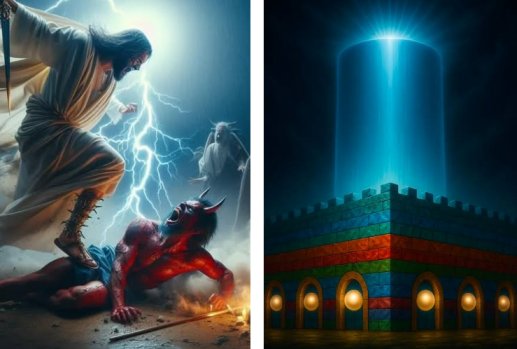
The story tells instead of the King, Yah'shua (Jesus), returning at Yom Teruah after a grand announcement in heaven by means of twin silver-trumpets (which is why one of its names is the Day of Trumpets), bringing with Him the Holy City or New Jerusalem, and the resurrected qodeshim (saints, set-apart ones) of the past, as well as those qodeshim (saints, set-apart ones) who are alive at His coming on the earth - resurrected in an instant (without tasting death) and being raised into the air a short way above the ground. They are raised or 'raptured' into that New Jerusalem (not into Heaven 'far away') where they remain...in the holy city which is suspended above the renewed earthly Jerusalem. Two Jerusalems, as I explained to you at this year's Yom Teruah.
Tracking Across the End of This Age & the Millennium
Then follow the Judgment at Yom haKippurim followed by the symbolically 7-day long Marriage Supper of the Lamb which lasts a thousand years. The moed or appointment of Shemini Atseret may then be correctly viewed as both the first day of the Millennium (on one level) and the first day of Eternity in the New Heavens and New Earth at Millennium's end. During the Millennium the New Jerusalem remains suspended above the earthly Jerusalem. The resurrected inhabitants of the New Jerusalem are sent on various assignments as rulers and administrators of the nations, thus having free access to the earth, whilst mortals, who are unresurrected, do not have access to the Holy City above them. Then, at the end of the Millennium, the New Jerusalem is fully manifested in our space-time, finally comes to rest on the earth, and that is the point at which Heaven and Earth become inseparably connected and thereafter indistinguishable. The old earth melts with a fervent heat (2 Pet.3:10) and the Universe is permanently one and at peace.
The Meaning of 'Atseret' & False Kabbalistic Ideas
You might think that that is an awful lot to distill out of almost no Scriptures on the subject at all (Lev.23:36,39; Num.29:35-38; 2 Chr.7:9; Neh.8:18). However, it is not distilled on the basis of only the six known passages. It has been extracted from the entirety of Scripture of which the word atseret is the springboard. It means, quite literally, 'restraint' or 'holding back', from which we get the picture of pilgrims remaining an extra day after Sukkot. But it's deeper mystery is hidden up in Christ whom Judaism rejects. Thus Jewish mystics like the kabbalists take this word and claim it means that this 8th day is a day to 'retain' all the 'spiritual energy' gained throughout the intense High Holiday season beginning at Rosh haShanah (which is their mutilated version of Yom Teruah), Yom Kippur (their shortening of Yom haKippurim), and Sukkot, as though it were something that could be bottled up and sold like 'holy water', that can then be released or dispensed into the ordinary months that follow, as if Yahweh is incapable of dealing with men and women with the same degree of Ruach (Spirit) as at the festivals.
'Atseret' Seen Through the Messianic Lens
So what does 'atseret' mean in the messianic narrative? What is being 'held back' or 'restrained', aside from the Sukkot guests who are being asked to tarry (remain) another day after Sukkot's conclusion? Well, for one thing, there is lots of scripture that speaks of how Elohim (God) restrains evil or lawlessness, such as we find in 1 Thessalonians 2:6-7. This makes sense when you think about both the beginning and the end of the Millennium. How so?
What Happens to Satan & His Angels, & Exactly When?
Well, at the Second Coming and during the autumn festivals, what happens to Satan and His fallen angels or demons? They are literally cast into the Pit where they are restrained or imprisoned for a thousand years so that man may live in peace - both the qodeshim (saints, set-apart ones) of the first resurrection (whose abode is the Holy City hovering above Jerusalem) and (most importantly), those mortal men and women who survive the Great Tribulation but are not resurrected and/or the offspring of the first resurrection believers who are mortal and, as we are told in the Tanakh (Old Testament), shall live to a very great age like the patriarchs of old (Is.65:20) - indeed, almost the entire span of the Millennium when they will be tested again. How? By the restraint being removed from Satan and his demons who are thereby able to escape the Pit and roam the earth once more to tempt those born during the Millennium (Rev.20:7-10). And then what happens after they have been tempted? The dark forces are once more 'restrained' and cast back into the Pit either to be imprisoned forever or, in the vew of some, annihilated (which of the two doctrines is true is unimportant here). That is why I say the 'atseret' or restraining is on two levels - at the end of the current æon or age and at the end of the millennial æon or age. That, in my view, is the primary meaning of Shemini Atseret.
Conclusion
But for those who are judged worthy to inherit the first resurrection, Shemini Atseret is a new, first day - a symbolic 'eighth' day of Sukkot and the literal first day of the Millennium...and also, at the millennium's end, the first 'day' of eternity. That, in a nutshell, is what Shemini Atseret is all about and why it is so important...not a mere afterthought for the benefit of a King who is sad to be parted from his Sukkot guests. For in truth, the King will never be parted from them!, or we from Him! We shall be together with Him forever and ever - le-olam-ve-ed. Praise Yah! HALLELU-YAH!
 V512
V512

|