

 721
C.S. Lewis
721
C.S. Lewis
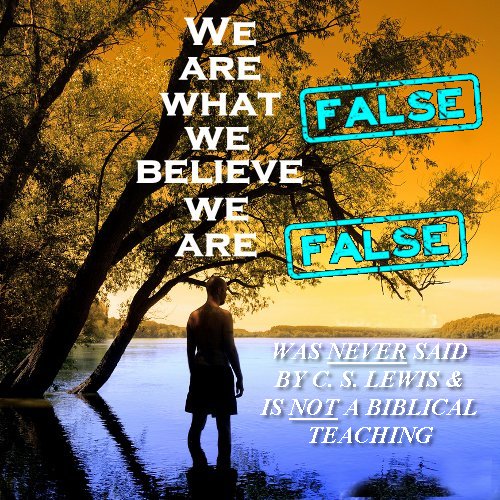
"We Are What We Believe We Are"
Beware of Internet Folklore!
An Oxonian & an Anglican
As an Oxford man and a one-time Anglican, C.S.Lewis (who was both an Oxonian and an Anglican) was one of my heroes. I have visited various Bodleian Library exhibitions which houses one of the largest collections of C.S. Lewis manuscripts globally, including drafts of essays, fragments of books, and personal letters. I still carry in my wallet my Bodleian Library Readers Card. I know well the picturesque 'Eagle and Child' in Oxford, the famous pub where Lewis and J.R.R. Tolkien met with their literary group, the 'Inklings'. And, most important of all, I possess and have read all of Lewis' Christian Apologetics books and raised my children on his Narnia stories. You can't be an Anglican Christian in Oxford and not know C.S. Lewis.
He Never Wrote These Words
Go online and type, "We are what we believe we are", select 'Pictures' or 'Images' on your Browser, and dozens of pretty memes will pop up with Lewis' name appended to these words. But C.S. Lewis did not say "we are what we believe we are". There is no record of this statement in any of his books, essays, or letters. But it is one of thousands of urban legends on the internet which Christians often uncritically quote as gospel because of this man's reputation. It is part of internet folklore which hardly anyone bothers to check out properly. Myself included, until yesterday.
An Urban Legend
The line is widely shared on social media and quotation-filled websites as a C.S. Lewis saying, but serious researchers of his work classify it as a misattribution. Most important of all, though, "We are what we believe we are" contradicts his own theology. Scholars have noted that the sentiment goes against Lewis’s actual philosophical and Christian writings — such as his famous work, Mere Christianity, where he argued that objective reality does not change based on what a person merely imagines or believes about themselves. nccg.org/critical_realism.html
Lies
Let's not beat about the bush: both the statement, "We are what we believe we are" and its attribution to C.S. Lewis are LIES.
How Internet Folklore Starts
How did this internet folklore begin? Probably innocently enough. Indeed, I had heard something like this expression from the Bible itself where doubtless this legend started, my research leading me to the King James Version (KJV) of Proverbs 23:7 which reads:
"For as he thinketh in his heart, so is he" (Prov.23:7, KJV)
A Huge Assumption on My Part
I was raised on the KJV so I had no reason to doubt the authenticity of this translation. But is was a false assumption on my part. I have learned a lot about the 'tyranny of assumptions' over the years.
The Men Who Translated the KJV
Why the 'First Cambridge Company', which included key scholars such as Edward Lively, Laurence Chaderton, and Francis Dillingham, translated Proverbs 23:7 this way in 1611, completely baffles me now because it is completely WRONG. No Bible since the Revised Standard Version (RSV) remotely resembles their translation of this passage.
Context is Everything
Let's first give this statement its original King James context:
"Eat thou not the bread of [him that hath] an evil eye, neither desire thou his dainty meats: FOR AS HE THINKETH IN HIS HEART, SO [IS] HE: Eat and drink, saith he to thee; but his heart is not with thee" (Proverbs 23:6-7, KJV).
Modern Translations Straighten Out the Error
Take any modern translation you like and you will soon understand the context. We'll take the New International Version (NIV) since it is such a popular dynamic-equivalent translation and one I am familiar with:
"Do not eat the food of a stingy man, do not crave his delicacies; FOR HE IS THE KIND OF MAN WHO IS ALWAYS THINKING ABOUT THE COST. 'Eat and drink,' he says to you, but his heart is not with you" (Proverbs 23:6-7, NIV).
Modern Versions Correct the Error
Check out any modern version (excluding the NKJV and Amplified Version) you like and you will see they all align with a correct translation of the Hebrew of which the NIV is pretty representative. THE WRITER OF PROVERBS IS NOT MAKING A DEEP STATEMENT ABOUT SPIRITUALITY, PSYCHOLOGY OR PHILOSOPHY. He is simply noting that a mean, stingy man is only thinking about the cost of the food he is reluctantly giving his guests. Nothing more. This is a proverb, after all.
Jacobean English is Not Contemporary English
And remember, KJV (Jacobean, 17th century) English is NOT modern English, and reads very differently to the English in use today, or even the standard English of my childhood in the 1950's. So unless you are a competent linguist and can properly translate the English of 500 years ago, the KJV is best left as a piece of brilliant literature that shaped the evolution of our Anglo-Saxon tongue...unless you are conversant in, and love, the language of Shakespeare, of course. I still use the KJV, but warily.
The Hazzard of King James Version-Onlyism
I have noticed therefore that most KJV-Onlyers have a poor grasp of the original text, claims to the contrary. My own brother-in-law, who was an ardent KJV-Onlyer, admitted to me one day that he kept an NIV alongside his KJV so he could understand the latter! At least he was honest. For more on the KJV-Only cult, see my KJVO website.
Not Really
So does the Bible teach, "We Are What We Believe We Are"? Not really, but New Ageism absolutely does as I know from personal contact with Subud which once I investigated, and with Buddhism - see my life story and how I came to Christ here
A Half-Truth
The Bible teaches that our identity comes supernaturally from YAHWEH, our Heavenly Father, yet what we think absolutely matters. So the statement is only a half-truth. And half-truths can be exceedingly dangerous.
Self-Definition is Anti-Scriptural
What the Bible does NOT teach (even though charismatic Christianity does) is the modern idea of 'self-manifestation' or that we become whatever we choose to believe about ourselves. 'Name it, and claim it' is one such iteration of this false thinking. Post-modernist identity politics (wokeism) is another. Like it or not, a person who believes he is a cat isn't one. So instead of self-definition, scripture repeatedly tells us of Elohim's (God's) definition of who we are.
Four Primary Biblical Teachings on Thoughts & Beliefs
Let's unpack that carefully and see what Scripture actually says about thoughts and beliefs.
- 1. Mind renewal. Romans 12:2 tells believers to transform their minds instead of copying the world's ways. We do have to get our thinking right. Absolutely. But it does not define us. We are defined supernaturally by the indwelling Ruach haQodesh (Holy Spirit) and by the inspired Scriptures confirming with the Ruach (Spirit) tells us. The Bible enables us to correct our subjectivity.
- 2. Truth over inner feelings. Jeremiah 17:9 warns that the human heart is deceitful, meaning our own internal ideas can be (and very often are) wrong because of the numerous ASSUMPTIONS we make, many being UNCONSCIOUS of these. They are mostly inherited by TRADITION and MEDIA PROGRAMMING but also by faulty thinking.
- 3. Where the Concept Differs. Here's the crux of the matter: Identity is RECEIVED, it is NOT created by us! Ephesians 2:10 says believers are Yahweh's workmanship created in Christ, meaning identity is a gift from our Heavenly Father rather than a product of positive thinking. I learned early on as an investigator of Buddhism that this is how all false religion thinks: 'Positive' is good, 'negative' is bad. Not so. Yahweh, Yah'shua (Jesus), the prophets and the apostles had LOTS of helpful and necessary positive AND negative things to say - they're simply different sides of the same coin of truth nccg.org/truth.html . Indeed, one can be positively and negatively WRONG. So beware of false dichotomies - Satan thrives on them.
- 4. Finally, dependence on Yahweh. Yah'shua (Jesus) states in John 15:5 that apart from Him, people can do nothing, pushing back on self-reliant power and repudiating any claim that we can create our own identity through our thoughts or feelings.
THAT'S the difference between Christianity and the Occult/New Age.
Conclusion
C.S. Lewis not only never taught "We Are What We Believe We Are" but neither does the Bible. So it's not as though we can legitimately borrow it from the psychologists who got it from eastern mysticism. We can't. Those that do teach it are spiritually compromised. In practice, what this tends to indicate is that the promoters of this doctrine are listening more to 'inner voices' than they are to the written Davar (Word) and the Ruach (Spirit) that inspired it. There's more than one spirit lurking in the dark out there and near our ear - we are given the Bible to discern between them. That's what Scripture is for, to preclude self-deception. So noses down, and eyes open!

This page was created on 30 July 2026
Last updated on 30 July 2026
Copywrite © 1987-2026 NCAY - All Rights Reserved