|
 
 282
FILIOQUE
282
FILIOQUE
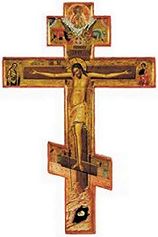
A Controversy that Illuminates the Godhead
In about the 6th century AD there was a controversy that caused a major stir in Orthodox Europe which has come to be known as the Filioque Controversy. The word filioque is the Latin means "from the Son" and is an expression that was inserted into the Niceno-Constantinopolitan Creed at the third council of Toledo in AD 589 in opposition to those who held that the Ruach haQodesh (Holy Spirit) proceeds only from the Father. The purpose of this addition was to establish as dogma once and for all that the Ruach haQodesh (Holy Spirit) proceeds from both the Father and the Son.
Though we cannot be sure why this insertion took place at this time it was probably a reaction to Arianism (of which the Jehovah's Witnesses are a modern example) which maintained that Christ was a lesser god to the Father. In AD 767 the Eastern Church (based in Constantinople/Byzantium) accused the Western Church (based in Rome) of heresy on this point as well as charging it with sacrilege in corrupting the creed of the universal church by adding the word filioque. Initially the Western Church, under Pope Leo III, compromised by omitting the offending word yet all the while maintaining the doctrine, before adding it to the creed under Pope Nicholas I. It has ever since been included in the Western (Catholic and Protestant) creeds in defiance of the Eastern Orthodox Church which regards the affair as a blasphemy. (see Postscript below).
Now why should we as Messianic Evangelicals be interested in a creed that we do not use? And is such a distinction regarding the Ruach haQodesh (Holy Spirit) important? If coming to an understanding of what or who the Elohimhead (Godhead) consists then, yes, this is an important matter, for it will very much alter our perspective on the purpose of life.
To begin with, the Western Church has always admitted that the insertion of filioque cannot be justified by the words of Scripture itself but by deductions of Scripture, in other words, by interpretation. And whilst interpretation is, to be sure, both commendable and necessary, we must be careful not to enshrine into dogma a point of theology that may legitimately be interpreted in different ways.
First the Scriptures in question used as proof-texts by the Western Churches:
"And because ye are sons, Elohim (God) hath sent forth the Ruach (Spirit) of His Son into your hearts, crying, Abba, Father" (Gal.4:6, KJV).
"But ye are not in the flesh, but in the Ruach (Spirit), if so be that the Ruach Elohim (Spirit of God) dwell in you. Now if any man have not the Ruach Mashiach (Spirit of Christ), he is none of His" (Rom.8:9, KJV).
One of the first remarks we are obliged to make is that the word "ruach/pneuma/spirit" has numerous meanings and may be used in both the impersonal as well as the personal sense, depending on the context. Another issue, discussed at length elsewhere (see Ruach haQodesh/Holy Spirit), is the fact that the Ruach (Spirit) has 'changed gender' because of the different grammatical rules of the languaged the Scriptures have been translated into. Thus in the original Hebrew (and Aramaic) the Ruach (Spirit) is always female but when rendered into Greek (as we find in our Greek New Testaments) ruach (Hebrew, feminine, 'she') becomes pneuma (Greek, neuter, 'it') and spiritus (Latin. masculine, 'he'). Because Protestantism is a break-off of the Western Catholic (Latin) Church, and because the Bible of the Western Church was the Latin Vulgate for over a thousand years in which both the Hebrew ruach (she) and the Greek pneuma (it) were translated as spiritus (he), the masculine identification has become part and parcel of the orthodox creeds and therefore of Western Christian tradition. That is why all our English Bibles (with only a few modern exceptions, like the Hebraic Roots Version, New Testament) always refer to the Holy Ghost or Holy Spirit as 'He' even though this is a mistranslation when referring to a Person. When referring to the impersonal, 'it' should be used.
To recap, then: in our English language we use the word 'spirit' (or 'ghost' in older English) to refer either to a person (e.g. "there is a spirit walking around the graveyard") or to the charisma of a person (e.g. "John has a warm spirit about him") which the context usually reveals. The same indistinction exists in the Hebrew (ruach) and Greek (pneuma), both of which are better rendered as 'breath'' or 'wind' (when impersonal). It is because of this problem that Christendom has divided over the issue of what or who the Spirit is, some (like the Jehovah's Witnesses, Seventh Day Adventists and many Messianics) maintaining that the ruach (pneuma ('it') is no more than an impersonal divine emanation ("breath") and others that He/She is a divine Person. Messianic Evangelicals have consistently maintained, when referring to the Third Member of the Elohimhead (Godhead), that "Spirit" should always be rendered in the female (She/Her), the situation of the word in the text usually rendering a clear verdict on whether a personal or impersonal usage may be ascribed.
As we look at the two key texts above in Galatians and Romans we see at once that it is impossible to say with any degree of certainy that a Person is being referred to. The very expression "spirit of" implies possession, so that the "spirit of Picasso" is the spirit, influence or charisma that belongs to the person "Picasso". Thus the "Ruach Elohim/Spirit of God" and the "Ruach/Spirit of Christ" may just as easily refer to the influence or charisma of the Father and of Christ as distinct Personages as to an independent third divine Personage called "The Holy Spirit". In that case, the use of He or She (depending on the Personage) is certainly appropriate.
To obtain a final resolution of this matter, as they suppose, Western divines appeal to the sayings of John the Apostle who writes:
"But when the Comforter is come, whom I will send unto you from the Father, even the Ruach Emet/Spirit of Truth, which proceedeth from the Father, 'he' shall testify of me" (Jn.15:26, KJV).
"Nevertheless, I tell you the truth; It is expedient for you that I go away: for if I go not away, the Comforter will not come unto you" (Jn.16:7, KJV).
From the point-of-view of the Western Churches, there are problems with these passages which also speak of the "Comforter" (Gk. paraklêtos), also rendered as Paraclete, Councelor, or Exhorter - literallly translated, "one called alongside" (see also Jn.14:16). Two points:
- Firstly, it is very clear that the origin of the Paraclete is the Father, not the Son even though Yah'shua (Jesus) has the authority to call upon the Paraclete to be sent (Jn.15:26). Thus we may say that the primary "attachment" or "association" of the Paraclete is with the Father.
- Secondly, the Paraclete is not able to minister to believers whilst Christ is upon the earth, indicating some sort of primacy on the part of Christ.
These two observations appear, at first glance, to be contradictory, for in the first the Ruach (Spirit) is shown to have a closer association to the Father than to the Son, and in the second, the Son is seen to exercise some sort of authority or possess some pre-eminence over the Paraclete. And it is such apparent "contradictions" that led early Church theologians to speculate as to the relationship between the three members of the Elohimhead (Godhead), leading to many theological and intellectual contortions to get the Scriptures to harmonise.
It is astonishing that it took the Western and Eastern Churches so long to arrive at a Godhead doctrine, to then finally disagree. Brilliant a formulation though the Trinity Doctrine may be (whichever of the two versions - Western or Eastern - you subscribe to) it is, in the final analysis, a deduction based on theological mathematics rather than a divine revelation clearly stated in Scripture, and it does in fact leave out one crucial fact, viz. that the Ruach haQodesh (Holy Spirit) is nearly always referred to in feminine terms in the Tanakh or Old Testament (see The Trinity: The Position of NCAY, "The Deity of the Holy Spirit", New Covenant Press, 1999, pp.6-14). Are we to conclude that the Ruach haQodesh (Holy Spirit) supernaturally changed gender between the Old and New Covenants? Or is there perhaps another, more reasonable and believable explanation?
Of the two traditions, we believe the Eastern Orthodox one is nearer the truth than the Western Catholic and Protestant ones. The Easterners, aware of the Old Testament teaching, wrestled with the gender of the Holy Spirit long and hard and at one time openly spoke of Her femaleness, referring to Her by Her Greek appellation, Sophia (lit. "wisdom"). We learn from the Old Testament, and specifically from the writings of Solomon, that the Ruach haQodesh (Holy Spirit) was a special creation ('derivation' is perhaps a better word) of Elohim (God), making Her a special bosom companion in a manner not dissimilar to that of Eve to Adam. Thus we are able to understand how, as John tells us, She "proceeds" from the Father.
Christ the Son, however, is neither a special creation (like Adam) or derived (like both Eve - from Adam - and Sophia from Yahweh the Heavenly Father Himself), but is eternal and uncreated, and so equally we can understand how He occupies a place of authority over Her to the extent that He can call for Her to be sent from the Father, as also John points out. The puzzle is nearly solved and indeed would be complete were it not for the fact that the Ruach haQodesh (Holy Spirit) in the English translations of the New Testament, as I have already pointed out, is nearly always rendered in the masculine form as 'He' and 'Him'.
It is this one (but not unimportant) point that has led many investigating the Messianic Evangelical claims and teachings to shy away from the issue and to remain with the classical Trinitarian formulation(s). When pressed to harmonise the Scriptures, the reaction is either to avoid the issue together and appeal to 'tradition' and the supposed authority of human-convened 'councils', or to seek an explanation as extra-biblical as the Trinitarian formulation which they seek to defend, viz. by turning to such traditions as kabbalism (as many messianics do) which teach that the Spirit is, in a sense, twin-gendered or hermaphrodite, a dangerous recourse indeed which ultimately leads to pantheism and occultism; for if the Ruach (Spirit) is hermaphrodite (both male and female simultaneously) then what is to stop us from saying that the "Father" is also hermaphrodite, whom perhaps we should more accurately call "Father-Mother" as many New Agers, liberal Christians and modern 'Christian Essenes' do? But to do this is to overturn the Scriptures entirely and their clear witness that the Father is male. No, the kabbalistic solution is no solution at all for its doctrine is, ultimately, pagan and antithetical to the Bible. What "comfort" such a doctrine may confer in the short term to those unaware that the Ruach (Spirit) is our Mother cannot compensate for the gaping defects and implications such a doctrine has on the wider issue of Who Elohim (God) is and the important differences in male and remale rôles, particularly in the matter of authority.
So what is the solution to the claimed masculine gender of the Ruach haQodesh (Holy Spirit) in our English New Testaments? There are only two possible resolutions:
- (1) The influence, presence or charisma of the Elohimhead (Godhead), consisting of both Male and Female personages, is defined in terms of the presiding authorities: and since the male Father presides over the female Ruach haQodesh (Holy Spirit), and as the eternally pre-existent male Son has authority to send Her from the Father, so Her presence and influence may, in some circumstances, be described as "He", "His" or "Him" to honour Her Head; and
- (2) The New Testament was originally written in Aramaic for the most part (Matthew may have been written in Hebrew), which is a semitic language related to Hebrew - and purer than Greek - in which the female nature of the Ruach haQodesh (Holy Spirit) would have been clearly shown, but which has now been obscured by translation, different languages attributing different genders to different nouns (as, for example in English or Russian, where we refer to our country as the "motherland" whereas in German or Scandinavian it is referred to as a "fatherland").
Though there is some considerable evidence that most, if not all, of the New Testament was originally written in Aramaic and subsequently translated into the lingua franca of the day (most scholars agree that Matthew was originally composed in Hebrew, as I said), there is no doubt that of the two explanations the first is the more plausible, though this does not exclude the possibility that both are true. Either way, the Western and Eastern Churches' doctrines of the Elohimhead (Godhead) are defective inasmuch as they omit the female aspect of Divinity, having created, as they have, a sterile all-male Deity. This neglect may well explain the Mariolatry that emerged in both (most pronounced in the Western Catholic Church) and the anarchic schism in the Protestant Churches which have no female counterpart to the Father and Son at all: which partially explains, I suspect, the move towards liberalism and its acceptance of many New Age ideas.
There are no Fathers without Mothers as the Mormons remind us, though in defending a quite different as well as heretical teaching. The opening up of the Elohim (Godhead) question quite understandably leaves many Christians uneasy in a world saturated with feminism and New Age/occult mother-worship, and I sympathise with their fears because to challenge a long held dogma is an open invitation to apostacy in the form of a return of worship to the "Queen of Heaven" (Ishtar, Easter, Tammuz, Diana) unless one is very careful, an idolatry for which Israel paid dearly. However, if we adhere closely to the Davar (Word, Scripture) we need not concern ourselves unduly, for we are not by any means turning to mother-worship in the least: to honour the Heavenly Mother is not the same as worshipping Gaia or Tammuz: for one thing we are commanded to worship, and pray to, the Father through the Son in the Master's (Lord's) Prayer. No other formula has ever been given us and none other ever will. Adam stands at the head of Eve and of his family for ever even as the Father stands at the head of the Mother.
I believe that the Filioque Controversy stands as a reminder to us that the classical Trinitarian model, brilliant and honourable a construction as it is (its purpose being to counter gnostic heresies), is nevertheless defective by its omissions, and should not be seen as anything more than a worthy speculation. In the final analysis, it is extra-Biblical, a point that seems to be lost to those Protestants who maintain that only the Bible is their rule of faith (Sola Scriptura - Scripture Alone). For in being required to accept the Trinitatian formulation as a test of faith we are being asked to comit the same sin as the Mormons in demanding allegiance to other scriptures such as the Book of Mormon - we are being asked to accept the Word and the doctrines of men, however sincere and purely motivated those men may have been. In the end it is "Christianity-plus".... Christianity with a little bit extra tacked on to it, a dangerous formula if the "plus" blinds us to seeing great and glorious truths yet hidden in the Word.
The truth, however, remains - that same "Spirit of Truth" sent from Elohim (God) that is crying out to teach us something wonderful about the Elohimhead (Godhead) - that in addition to a loving Heavenly Father there is a loving Heavenly Mother (Jn.15:26). She is a gift from Elohim (God) and has an active and vitally important salvational ministry to the Messianic Community (Church, Body). She is our Comforter sent from the Father at the request of the Son. I myself have both seen and heard Her which, I suppose, makes me somewhat biased in Her favour! Nevertheless, in spite of my personal testimony, my justification for preaching this doctrine rests ultimately with the Davar Elohim (Word of God). And it is to that that the Body of Christ must all finally turn to establish the truth.
24 January 2001, revised 29 November 2025
POSTSCRIPT
On 23 November 2025 the Roman Catholic Pope, Leo XIV, released an 'apostolic letter' in Unitate Fidei, in which he redefined the doctrine of the Filioque, previously treated as de fide or infallible Catholic dogma. He did this for the sake of 'Christian unity'. So the Roman Catholic Church now presents the Nicene Creed in its AD 381 form by omitting "and the Son", and declares that the Filioque has "lost its raison d'être". [1]
This makes the Protestant Churches the only ones to now retain the Filioque.
29 November 2025
Endnotes
[1] Unitate Fidei - Apostostolic Letter of Pope Leo XIV

This page was created on 24 January 2001
Last updated on 24 January 2001
Endnotes Copyright © 1987-2025 NCAY - All Rights Reserved

|