

Chapter 3
First Impressions
Second Expanded 2026 Edition
I don't know how long I slept. All I remembered upon wakening was snippets from my flights and train journeys to Europe, life in Kansas City, Stan, and almost everything that had been going through my mind the past few days.
The ringing of a bell summoning the family to dinner jolted me out of my sleep. I was up on my feet like a school girl afraid to be late for class, made a quick adjustment to my hair, and leaped out into the corridor like a doe. Stan's room was at the other end of the corridor and he had emerged at precisely the same time as I did. I tried to think what to say to him but was saved the effort by Kryztina coming out of the kitchen between us.
"Hi, Hélène!" she called out hurriedly crossing into the dining room with a last minute afterthought for the table, and was gone before I could reply.
Stan and I met mid-way. "Did you get a nice rest?" he enquired with a soft smile on his face.
"Yes, thanks," I replied as he ushhered me into the dining room and showed me to my seat next to him.
The family were filtering in and taking their assigned places. Stan rotated the seating arrangement every month to be fair to everyone. This month Suszana, the eldest of his wives, sat on his right at the head of the long mahogany table and I to his left. The cook of the day was Kryztina who sat at the other end of the table opposite Stan. Around the table sat his other wives: Isabel, Kasia, Sarah-Jane and Anna, six in all, with children sandwiched inbetween them. The smaller children only ate separately if Stan had special guests and time was short or if he wanted greater quiet in order to conduct business at the meal-table, or if he had something he urgently needed to discuss with the wives that was not for children's ears. Isabel sat to my left, with her son.
Suszana was Stan's eldest wife and only three years his junior. She was the "wife of his youth" and judging by her appearance - elegant clothing, tasteful but modest jewelry, and her deportment - was well cultured and had a hint of the aristocratic about her. Now in her mid-forties, she had evidently been a ravishing beauty in her youth, but still possessed a magnetic charisma and elegance. Tonight she looked as though she had come out of some film about the Arabian Knights.
Suszana was Eurasian, in fact, part Polish, part German, part Turkish and part Bulgarian, with a bit of this and that in addition. Her father, of German-Polish extraction from Kraków, had been a Polish consul in İzmir, formerly Smyrna, before the war but after the defeat of Poland in 1939 suddenly found himself without a country. Given only 24 hours to pack his bags, he had virtually become a gipsy wandering the Balkans as he tried to stay one step ahead of the advancing German Army, first moving to Belgrade, then to Bucharest and finally, Sofia.
It was in Sofia that he met his future wife, of Turkish extraction though with some Bulgar blood and, Stan believed, some Greek too. They literally married "on the run" in a border town in Greek Macedonia, escaping the German occupying forces from the port of Thessaloniki on a tramp ship headed for the French Levant. From there they had made their way to the comparative safety of British Egypt where they spent the duration of the war.
From Egypt the couple moved to back to Poland at the end of the war and narrowly escaped the communist take-over in 1947 by making their way to the Danish island of Bornholm in a German fishing boat. There they settled, eventually obtaining Danish nationality in 1952, and there Suszana was born some years later.
Her jet black hair, olive-brown skin and green eyes attested to her genealogical origin, her mother's genes clearly predominating. And her four children were quite a cocktail of characteristics too - blonde, brown, and black-haired, two with milky-white complexions and two clearly Asiatic and Slav. Two were Stan's and didn't look like each other at all, and two were from previous relationships. Though illegitimate as far as God's laws were concerned, Stan treated the latter as his own. They were well-loved.
I learned from Isabel that Suszana had left Stan when he had made it known that God had called Him into plural marriage, a fate that I discovered awaited many first wives in the early days of the patriarchal movement. She had wandered from one relationship to another until, fifteen years later, she suddenly woke up one day and knew that she had to go back to Stan, with two girls in tow.
It had taken her a while to settle back into family life for not only did she have to share five other wives with her husband, whereas before she had had him to herself (not counting Isabel with whom she had shared her husband for a week before abandoning both of them), but also had to get used to a very different Stan, many more children, a new home and a new city, Lublin being very provincial compared to the elegance of Kraków. But she had made the adjustments in spite of the challenges and was reasonably settled. There were still many things she had not worked out in herself but given her turbulent past - every bit as dramatic as her parents' - she was getting there in small increments.
Isabel was the only other wife to have once left him, being originally his second wife, and returning to him after three years on her own (five in total, including the two she "half" lived with him), to become his present third wife after Kryztina and Kasia. After Kasia came Sarah-Jane from Saskatchewan, Canada and Anna from Krasnopol, Poland. All had colourful stories to tell making the Królewiecs one of the most fascinating families I have ever met. Beneath one roof were not only many different nationalities but a wealth of personal experiences that would in themselves form the bases of several gripping biographies.
After Stan said grace conversation darted back and forth on a number of subjects, with children and the attention they demanded dominating proceedings. I mostly told them about myself and how it was I came to be in Lublin though all the wives seemed to be pretty well versed in my background already. Inbetween courses Stan and Suszana held hands and throughout the meal Stan threw affectionate glances to his other wives. There was a constant romantic play in operation at all times with wives signalling with their eyes and smiles from afar and occasionally coming closer to steal a kiss or a hug.
Stan never seemed too busy to share his affection and the wives never seemed to tire of it either. Rarely, save when he was locked away in his office, was there not a wife at his side snuggling up to him on a sofa, sitting on his lap in tender embrace on a chair, holding hands, or walking with arms around each other strolling in the garden. Sometimes he would attend to two wives simultaneously. One early morning I saw him in the back garden through my bedroom window with Kasia and Sarah-Jane either side of him, and Anna on Sarah-Jane's free side, all with arms around each other like an interwoven wicker basket. It was so beautiful. No matter what time of the day the atmosphere seemed charged with romance and so commonplace had it become that nobody thought twice about it. It was all so effortless - so natural - that from the very beginning I began to harbour a secret envy.
Where was all the jealosy I had expected? Stan's policy of doing nothing behind locked doors gave all the wives a deep sense of security. A wife could come into a room to find Stan in passionate embrace with another and know that she was not intruding. I saw it so many times.
On my second day I saw Stan kissing Sarah-Jane when Kasia came into the room. Kasia just smiled to see the happiness they were sharing and without any sense of shame or uncertainty just walked up to the couple, and put her arms around both. Stan and Sarah-Jane stopped kissing, smiled at Kasia, and then Stan kissed Kasia with long, deep and lingering intensity while Sarah-Jane gave Kasia a sweet kiss on her lips when she was done with Stan, all whilst still holding each another and looking deeply into each others eyes.
I couldn't believe my eyes at first. How did they manage it? I learned that all the wives were so secure in Stan's love for them that they not only knew that he loved all equally but had discovered a love that was infinitely more deep and satisfying that came from their sharing, for they loved each other too.
It hadn't always been that way. All had struggled at the beginning of their marriages, some more than the others. It had been particularly hard for those who were shy and not outward-going, like Isabel, or those who became self-conscious because of age or because they were losing the battle to shed unwanted weight.
Stan taught the more spontaneous wives to develop an awareness of those who were still introvert and to encourage the latter. At the same time he expected the more shy to work on their reservation. He was, and still is, a great believer in the potential for change and growth given enough determination, good will, patience, and love.
Anna, like Isabel, had also been a shy one, who preferred to shrink in a corner and await her night with Stan before showing any open affection to him. As a result of this she began to develop the destabilising monogamy-only mindframe, seeing herself as exclusively his on Mondays and as being romantically away on holiday on the other days. The result was that she erected spiritual and emotional barriers between herself and the others, and the family was no longer one. Stress resulted. Stan had resorted to drastic action: he abolished her exclusive visiting rights completely and made visiting him an open house on her day for a month with her right to drop by on the night of anyone who had dropped by on her night!
Anna's false dream world shattered. Whenever she came to Stan's room hoping to find him alone on another wife's night who had previosuly dropped by on hers, there was always someone else there and they always left so she could be alone with him. She felt more and more guilty after a while, broke down in tears before all her sister-wives one day, and expressed sorrow for her selfishness. Stan continued the open-house system nevertheless, only this time when another sister-wife came into the bedroom when Anna was with Stan, Anna had to leave! At least until the month was up until the lesson was learned.
There was, of course, more to it than this. Stan would spend much time talking to his wives with problems. He was never cruel though his solutions to some kinds of problem seemed draconian at times. He recognised a clear distinction between carnal and spiritual issues: to the former he gave no quarter, and on the latter he poured flaggons of grace and mercy. He treated jealosy like a cancer and his cure was sometimes harsh. But he always got a cure.
I, with my female inclination to show a surplass of mercy even on carnal sins, was, in the early days, appalled by some of Stan's methods. Isabel ran away from him three times, and on the third stayed away a year. But she came back almost completely cured.
Stan, I soon learned, had the unenviable balancing task of ensuring that personal needs did not compromise the general needs of the whole family. He used as his model the New Testament Church with the equality of its members before Christ but with their functional differences intact. He saw his rôle as a kind of family pastor, keeping the family on-track, pouring his love on it whilst holding a tight rein. Trouble-makers had to be ministered to, encouraged to reform, given space for repentance and, as a last measure, thrown out of the fellowship for the sake of the fellowship. In spite of the deep love he felt for all his wives, he was not above throwing them out if they went over the borders of acceptable conduct.
Sarah-Jane was to learn the hard way. She was young, beautiful and very attractive when she joined the family and the love she and Stan had for one another was deep from the beginning. But she soon developed a bossy tendency and wanted the house run along her lines. She became contentious with her sister-wives and created much ill-will. In the end, Stan simply told her one evening when all the wives were gathered that unless she submitted herself fully to his authority she would have to pack her bags and leave Raj within 24 hours. She didn't believe him and convinced herself that he was so dependent on her love that he would never do such a thing.
The next day she went out to Lublin believing that everything would be the same upon her return at the deadline. Finding her bags all packed on the doorstep and the front door bolted came as a terrible shock to her. She had yelled and screamed to be let in again. Stan had spoken to her from the living room window and said that he had meant everything he had said. The truth slowly dawned on her that she wasn't going to get away with her rebellion. She had begun to plead with him, using his love for her as an emotional lever and bargaining chip. But he would not budge.
"You must learn," he said gently out of the living room window, "that the welfare of the whole family comes before selfish ambition, that I am its head, and that I expect my wives to obey me, just as Christ is the head of the Church and I, as a Pastor, must obey Him."
She protested in vain.
"There's a $15,400 check in your handbag, the amount you brought here when you came. All your belongings are packed. If you like I can call a taxi for you to take you to the station in Lublin. There's an evening train to Warsaw that leaves at 8.35 p.m. You can spend the night in a hôtel and book a passage back to Canada. I can make the booking for you here and have the tickets delivered to your hôtel."
Sarah-Jane had begun to cry. "Don't you love me, Stan?"
"Yes," he replied, "with all my heart. But I love Christ more than you, and I love all your sister-wives equally to you. You are on a course different to us. I cannot go in two directions. Either you must follow us or go your own way."
Sarah-Jane was back in the house after a two hour impasse outside the door. Most of the family was looking on through the nursery and front apartment windows. She had made a spectacle of herself and knew that she must either yield or leave. She had weighed up all that she had and what she stood to lose and realised she had to swallow her pride and return. She was very contrite for weeks afterwards, not even visiting Stan at night. He, in the end, had gone to her, and started afresh. Sarah-Jane was never the same after that, to the blessing of all.
I learned that each woman entering the family had her individual Peniel - that place Jacob the deceiver wrestled with God all night until his selfish nature was burned out of him and he got a new name to reflect the spiritual change wrought . And I learned that everyone's Peniel was different but equally painful. Some are too personal to recount here. I had mine too but I shall say more of that another time.
------
"Did you find that cross-reference to John 12:25, Anna?" Stan suddenly interjected.
Theology was a common topic of discussion at mealtimes and when Stan was busy on multiple projects he would often ask a wife to help out.
"What's John 12:25 about, Stan?" asked Kryztina, the family's Bible mole.
"It's the passage about hating your own life," Anna replied. "We're trying to figure out how Yah'shua - that's the Hebrew name for Jesus, Hélène - how He uses the verb "hate". At first we thought this was purely a Johannine term but it isn't."
I was already lost. My future sister-wives were all accomplished scriptorians, just as Misha the Lithuanian had been at Blum's.
"I'm sorry, I'm not quite with you," I sheepishly interjected.
"Well," Anna continued, "John uses quite a different vocabulary to the synoptists, Matthew, Mark and Luke. For instance, he uses the word "light" as a wide-ranging metaphor in Yah'shua's sayings. Did Yah'shua actually use this Johannine vocabulary or did John purposefully modify the Saviour's words in order to be more readily comprehensible to his gnostic audience?"
I was still puzzled.
"What she means," said Suszana taking up the thread, "is that John translated the original concepts of the Gospel into his own peculiar style using words that would best be understood by his audience. For instance, you and Sarah-Jane are North Americans with your own special vocabulary which can sometimes be mystifying to Europeans like the rest of us who speak British English. The question we've been asking ourselves is what exactly did Jesus mean by "hate" since elsewhere He condemns hatred and commands us to love..."
"OK, I'm with you," I replied. "You're thinking of the time when Jesus said we should hate our parents..."
"And wives and children," added Kryztina, "brothers and sisters too..."
"Right," Stan picked up. "And don't forget that Luke reports that Yah'shua said we should hate our own lives too, confirming John (Lk.14:26). Since Luke was a doctor and didn't use Johannine terminology at all, we have to conclude that John reported a literal saying of Christ. That being the case, and knowing what we know about His teachings about love and hate, we are forced to conclude that in both the Johannine and Lukan accounts He isn't talking about literal hate. And if this is the case, then when John reports Yah'shua saying, "He who loves his life loses it", the word "love" cannot mean love in the sense in which we traditionally understand."
Stan paused, and there was silence amongst the adults as they sensed a new insight was coming to him.
"Obviously Yah'shua uses the word "hate" in the sense of regarding something as being of secondary importance. Thus, simply stated, He is telling us to put Christ before parents, family, and self. Most theologians recognise that - only the extremists who lack sound discernment assume that we are to literally cultivate an active hatred of someone. If this is so, then when Christ uses the word "love" He must surely want us to understand that to mean "of primary importance" rather than being in love with one's self. And if this is true, we may have to carefully reconsider what the Saviour means when He uses the word "love" elsewhere. It's more a question of emphasis than any new radical revelation, but isn't so much of the misunderstanding of scriptorians caused by wrong emphasis rather than by completely reading a passage wrongly?"
There were nods of agreement in the room. I never failed to be impressed by the fact that whenever Christ was the topic of conversation, all the adults spontaneously and enthusiastically engaged themselves in the discussion that inevitably followed. This was one of my strongest impressions of the Królewiec family, their complete interest in the Gospel. Everything was guided by it. It was alive to them.
Some of the wives discussed this theological tidbit further whilst others drifted elsewhere.
"Do you always have such scholarly discussions here?" I asked Isabel.
She gave a little chuckle. "Always! It's our bread and water..."
"...and cake and grape juice too," added Kasia. Everyone laughed.
"Or in your case, ice-cream!" teased Stan. Kasia giggled. Some of the children thought it was a cue for dessert and were slightly disappointed when fruit and cream were rolled in.
At length the clinking of spoons on glass bowls died down and everyone went silent as Stan rang a little brass bell on the table for the concluding prayer. The younger children left with their mothers for bed and the older ones for other activities. Kryztina and Sarah-Jane began loading the trolley with the mountain-load of washing-up. My offer of help was gratefully accepted and so I ended up with them in the kitchen.
"Where in Saskatchewan are you from?" I asked Sarah-Jane.
"Oh, you'll not have heard of it, Hélène," she answered. "It's a little place in the middle of nowhere called Tisdale surrounded by lots of other places nobody's ever heard of like Porcupine Plain and Nipawin."
Kryztina giggled as she started filling one of the three dishwashers. "Porcupine Plain - Stan loves that one!"
Sarah-Jane giggled as well. "Yeah, he always calls it 'plain old porky nips away with a yellah head' - you see, Yellowhead's another village nearby."
Kryztina hooted with laughter. "When Sarah-Jane told our Scandinavian visitors last year about her old home they were in stitches..."
Sarah-Jane began to heave uncontrollably - "You see...."
Kryztina shrieked, the tears rolling down her cheeks which were glowing red like charcoal on fire - "You see, Hélène, Tisdale..."
She creased up again: "You see, Tisdale in Swedish means 'pee in the valley'.
Howls of laughter again.
"Kryztina never told you where she comes from, I bet!" retorted Sarah-Jane, trying to be serious but making a bad job of it.
"I guess I'll find out sooner or later," I said trying to join in the revelry a bit, but in reality feeling it was completely over my head.
Isabel had by now poked her head around the kitchen door trying to find out what all the fuss was about. She and Suszana did not appreciate this sort of humour.
"Kryztina is from Krąpiel...."
"It's pronounced Kranpiel," snapped back Kryztina, pretending to be annoyed.
"Who cares," insisted Sarah-Jane, "it's spelled K-R-A-P-I-E-L!"
Isabel gave a disapproving grunt and disappeared.
"Where abouts is that?"
I tried to steer the conversation around to something else. Kryztina sensed that maybe they had gone too far.
"It's near Szczecin - maybe you've heard of it as Stettin?"
I hadn't.
"Well, it's in Pomerania not too far away from the German border."
All these foreign names were bewildering to me. Unlike Stan's wives who were all good geographers - they had to be with such an international, cosmopolitan bunch of women - my range of geographical knowledge stretched from the Rockies to the Appalachians. But I was learning.
Stan walked in.
"Are these ladies teasing you, Hélène?" he asked quizzically.
"Oh, no, no, I'm learning new things all the time."
Stan was as confused by my non sequitur as I was, but shrugged it off, putting it down to embarrassment and tiredness.
"Why don't you come along to the living room when you've had enough of their banter." Sarah-Jane looked a bit sheepish. "Kasia's making hot cocoa."
There was a sudden scramble to the door by the others. Indeed, that was all I needed to head south-west to the living room. I'm an addict of cocoa. I sensed that Stan knew my little secret. Of course he did, I must have told him when we swopped questionnaires about our likes and dislikes on the internet a few weeks before I flew east.
It was quieter with the smallest children in bed. Isabel had gone to read a bed-time story to Stanisław, Jr., and the older children were either watching TV in the classroom or nursery. I could hear the clack of balls as Suszana's eldest, both teenagers, played snooker, the European equivalent of American poole.
Stan came in, Kasia forgot she was making cocoa, and went to him for a hug and kiss. She was like that. Stan was her life and she saw stars whenever he appeared, and forgot everything else. But she was also his most avid critic and could make the rest of us cringe sometimes.
"What about the cocoa?" teased Anna.
"Oh, yes, sorry!" she said innocently, and went back to the by-now boiling canteen in the corner of the room.
Stan sat down and Anna snuggled up to him on the sofa. Isabel decided she would have the vacant side and swopped seats.
"Hey, what about me?" quipped Kasia.
"You've had your cuddle," said Anna jokingly. "Now it's our turn!"
Isabel gave a soft giggle and glanced at Suszana sitting opposite. She gave one of her huge butter-melting smiles at the silliness of it all. Stan shook his head slightly in disbelief. This had become an almost daily ritual which he tolerated because it broke down barriers and helped build up family cohesiveness.
"It's always like this," said Stan in a tone of mock resignation. "You wait until I get a lapful of children too!"
And he did. They marched to bed past him for a goodnight hug and kiss. Sometimes he would go off to tuck some in and then return.
The sun had set and it was dark outside. The wind was blowing and an autumnal shower was thrashing rain against the window panes.
"Darling, draw the curtains, would you?" he said to Sarah-Jane as she came into the room from the kitchen, and in moments we were sealed in, cosy and snug. Stan had lit a fire in the hearth and the flames leaped up into the chimney. The pine logs, carefully split and stacked by Stan and the boys, now yielded to the heat with a rhythmic, comforting cadence. Kasia served the cocoa and soon the room was full of a pleasant aroma and contented slurping.
Kasia, not to be outdone by Anna, sat on the floor at Stan's feet and leaned her head back on his knees, her cocoa assignment done. The room went silent save for the earthy notes of toasted pine as we stared into the fire and enjoyed our drinks. A deep, resonant purr vibrated from the the glowing embers, casting a long, flickering warmth that gently pushed back the chill of the evening. I felt a wonderful peace, as though I had been there for an age.
Oh, I liked this already! It was so different but so - so warm! Was it possible that I had found my paradise so soon? It seemed just too good to be true. And yet - and yet, this place seemed to be like an island in the sea of a very different world outside. Raj was a time capsule, a cultural ghetto which no-one else could possibly understand. How could I possibly share this with my friends and family?
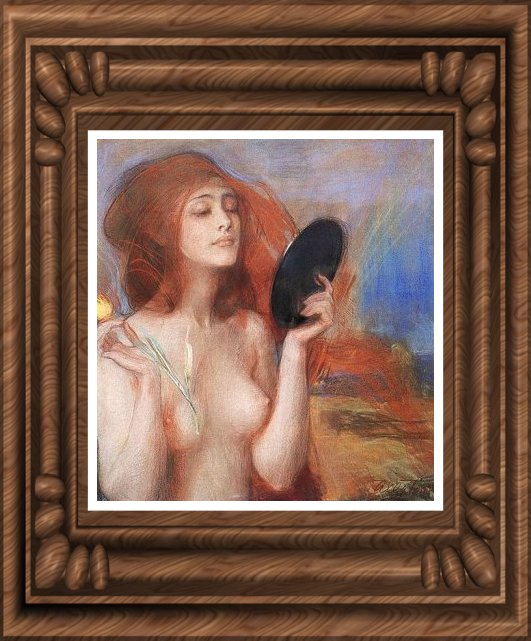
Suszana, who had changed seats, was now lying with her head resting on Isabel's right shoulder as though lulled into a quiet trance - it could have been a scene from a classical romantic 19th century Victorian painting by Lawrence Alma-Tadema or John Waterhouse whom Stan loved so much, an artistic epoch that was largely absent from the Polish experience because of its turbulent history. I glanced up at a painting behind the two best friends to the left of the fireplace, an imposing reproduction of Polish painter Teodor Axentowicz called Spring, one of the most highly prized painters of the Young Poland period, Stan would later tell me. He had painted it in 1900. This beautiful pastel on paper portrait of Ata Zakrezewska, which San had acquired in a Lublin market and often used to use as a teaching piece, was the artist's inspirational muse whom he had immortalised on canvas. For our husband she was a composite allegory of the beauty of the echad unity of plural wives in Christ, her nakedness an indication of Edenic innocence and openness being regained in pursuit of the vision given him by the Lord. In her right had was a tulip, a flower that blooms in spring. Her other palm held a mirror, which he used as a metaphor for us wives individually and collectively examining the soul through God's Word and choosing whether or not to act upon what we see.
Stan saw that I was in deep meditation as I gazed at the picture and broke the silence. "A penny for your thoughts, Hélène?"
I paused. "Oh, hard to say really. How do you share something wonderful with the world when they can never understand it?"
He smiled. "That's just how Christ felt. Do you remember how, heavy of heart, He once said that he wanted to share so much more with His disciples but they weren't ready?"
I vaguely recalled, and nodded.
"That painting has deep meaning for my wives and I. It's a constant reminder of who they are, why they are here, and what they have been called to become in me, their husband, and in Christ, our allegorical Bridegroom. The woman is looking intently into the mirror, looking for answers, as how best to realise that, don't you think?"
"Yes, yes..." I replied softly, deep in thought and still floating in the glorious atmosphere of the room.
"The deeper you enter into God's love and grace, Hélène, the fewer there are who can understand you...except those who are a part of our mystical unity. To join Christ's family you receive a double-sided blessing, like a coin. The one side offers you paradise, but the more time you spend there, the more starkly you see hell. The deeper you journey into heaven, the narrower becomes the Way, until you reach the point where you are completely alone in Christ. You can share only so much as you go deeper into the light. And you are able to share less and less of the deepeer truths except with those who are walking along the Way with you. You can relate certain things to the world but it is so very little.
"This path we walk, Hélène," he said, repeating my name as if to emphasise the importance of this learning experience for me, "is both the most intimate and pure inter-personal human relationship you can ever experience as well as being the most lonely. Your circle of friends shrinks the deeper into the light of Christ you go, and especially in our plural way of life, so finding others who share the same vision - whether wives or brothers and sisters in Christ - becomes an important driving force, because obviously we want - and need - to share our joy with others. In our fellowship there is this family and a dozen or so other ones, maybe a hundred souls in all. But because we're spread out all over the world the only real contact we have for now is right here in our family in Raj and on special occasions. So the love and unity we guard jealously.
"Our family is our ark of safety and fellowship in Christ. It's our all. We belong to Noah's world. That great and lonely man spent the better part of a century with only one wife, three sons, and three daughters-in-law - eight souls in all. That was his only company. And from his own age group, there was only his wife. We may never understand his loneliness and sadness. He lost all his other wives, with all their children, and all his grandchildren to the antediluvian world. All of them."
The 'coincidence' of Noah's eight and Stan's eight (if I joined the family) didn't escape me. It occurred to me that maybe this might signal a completion of sorts. Stan turned to Kasia and nodded her an unspoken message which she silently decoded, rose, and went to the HiFi system. Moments later Chopin's famous piano Nocturne in C-sharp Minor began softly playing, completing and perfecting the ambience and turning this into a cherished moment I would never ever forget, a moment when I first felt I really belonged.
"In this way of life, Hélène," said Stan, continuing, "there is much to potentially gain but also much to potentially lose too, because even the best of people are fickle, unpredictable, sudden and often irrational in the choices they make. That's why the mirror in this painting is so important, and why Scripture study is so central here. We are willing to sacrifice all for the vision we share. None of us would ever go back to what we had before in the world and it's precious moments like this, which I can see you're feeling, that remind us how precious this gift of family is. Better a dozen or so souls deeply in love with each other and centered in the light of Christ - and we really do love each other and God - than thousands of superficial relationships which are here today and gone tomorrow. That's the reality of the choice we have. We've made our choice to be here, to be transparent like the transparency of this painting, to love and support each other no matter what. We do make mistakes, as you've probably already seen, but we do our very best to right them. And it's my task as Head of the family to lead and support everyone under this roof. We're in our ark headed for millennial waters, waiting for the return of Christ and the Holy City, and there's little outside but dark and stormy weather. We know what we want. And anyone wanting to be a part of this family mustn't only want me, my wives and our way of life, but they must desire our vision too. The vision is so important."
I pondered Stan's words a long while. The choices I faced were great indeed. And though I hadn't been formally invited to be a part of Stan's family, we all understood that we were considering the possibility. I was taking stock of the Królewiec family, and they of me. I had a lot of questions, but I was still jet-lagged and tired after my long journey and needed to sleep.
There was a sharp crack in the fireplace as a log shifted and ashes moved. I stared into the flames and remembered what Stan had taught me in a letter about the fire we all had to pass through. We would either be burned or purified. I wondered what would happen to me next.


This page was first created in 2002
Last updated on 9 October 2026
No part of this work may be reproduced or stored on any
medium without the express permission of the publisher.
Violators of this copyright will be prosecuted
Copyright © 1987-2026 Chavurat Bekorot
All Rights Reserved | Alle Recht vorbehalten