Q. Leviticus 17:17 says that a man may not marry his mother-in-law. If God gave David Saul's wives to marry them (2 Samuel 12:8), then he would have been forced to marry his first wife Michal's mother (Ahinoam) too, wouldn't he? Since God forbade a man marrying his mother and sister, wouldn't that prove that 2 Samuel 12:8 wasn't David marrying Saul's wives but simply providing for them?
A False Assumption
A. This is an argument advanced by Alan Shlemon back in 2018 using most of the usual anti-polygamy arguments already soundly debunked on this website [1]. You (like Shlemon) are assuming that Michal's mother was still alive which we have to assume she wasn't otherwise the prophet Nathan, or some other court prophet, would have rebuked him as Nathan did when David committed adultery with Bathsheba. And since no such rebuke was ever given, we must conclude that either his mother-in-law was already dead or that she was excepted from any marriage arrangements in order to conform to the commandments.
Incest is an Abomination
To be perfectly clear, a man marrying his wife's mother, while both are still alive, is a form if incest or consanguinity known as nokrom in India (see the conclusion of this FAQ), and is an aboimination and strictly forbidden by God in His Law:
"'Do not have sexual relations with both a woman and her daughter. Do not have sexual relations with either her son's daughter or her daughter's daughter; they are her close relatives. That is wickedness" (Lev.18:17, NIV).
"'If a man marries both a woman and her mother, it is wicked. Both he and they must be burned in the fire, so that no wickedness will be among you" (Lev.20:14, NIV).
Execution by Burning!
This sin was so vile in God's eyes that it is the only one requiring execution by burning. Yahweh would definitely never make an exception, ever, because it violates the sanctity of marriage and the family. So you are perfectly right to be concerned. He would never contradict His own law without dethroning Himself. So if Michal's mother had been alive at the time of Saul's death, David could not - and would not - have 'married' her. The fact that the guilty man and mother were to burned to ashes puts this sin into a category all its own. It's a stark warning not to pollute the land as no trace of them is to be left, not even their bones, for burial. Indeed, I once knew of a polygamist who had married a mother and her daughter from a previous marriage and I sternly rebuked him, warning him that he was putting the salvation of his soul and that of the mother in peril, and cut off all contact him with him when he failed to respond.
What David Was, and Was Not, Guilty Of
David had many faults to be sure and was especially called out for his two most serious ones: adultery with Bathsheba and the murder of her husband, and paid dearly for these two heinous crimes. He was also called out for carrying our a census you will remember. But in the matter of sexual offenses, we are led to understand that only in the affair with Bathsheba was David ever in violation of God's marriage laws. He was never rebuked or punished for the imaginary 'sin' of polygamy (as most of Christendomn falsely accuse him of) - not he, nor any other Israelite, no provision being made to 'punish' polygamy anywhere simply because it was unpunishable. Rather, it is protected with certain responsibilities and provisions laid out for its righteous conduct.
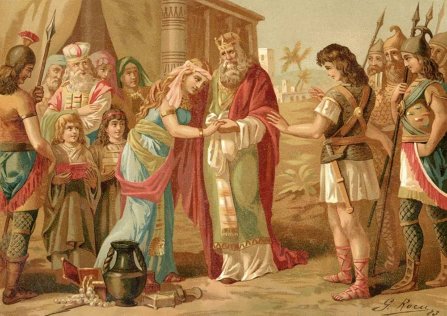 David's marriage to Michael, Saul and Ahinoam's daughter
David Definitely Married Saul's Wives
That's the first point. The second is that there is no way you can construe 2 Samuel 12:8 to mean anything else other than marriage. The language is explicit enough: "I gave you your master's (Saul's) house (family), and your master's wives into your bosom" (2 Sam.12:2b, NRSV). The family would have included his children, grandchildren and servants. We know he took care of those because of the story of Mephibaal/Mephibosheth, Saul's grandson (1 Sam.16:1,4; 19:24-25,30; 21:7-8). Saul's wives here are highlighted in addition to his non-marriagable kin, as if to make the point, the wives being especially singled out. The former would have been a practical responsibility of the new owner of all of Saul's " House[hold]", with the latter being personally desirable to David, and it is these wives (in addition no doubt to Saul's wealth and royal prestige, though these aren't specifically mentioned), that are the "more" (which are specifically mentioned) in "I would have given you many more" (ATOT [2]).
Christ's Own Alef-Taw Imprimatur in the Text
Yahweh leaves His Alef-Taw (Aleph-Tav) () signature or imprimatur twice in this passage in front of the word " house" to make sure we understand that David fully enjoyed everything Saul had once possessed, including his wives, as wives, as the intended meaning. Remember also that the 'Alef-Taw' is Christ's description of Himself in Revelation 1:8, 21:6 and 22:13 and thus links the Saviour directly back into the Old Testament where this untranslated code appears approximately 7,000 to 11,000 times, depending whether you only count the stand-alone instances or include the various cognates too [2]. This is itself strong evidence that plural marriage was not simply a temporary 'Old Covenant' phenomenon that was 'abolished' by the cross since Yah'shua (Jesus) has 'initialled' it, thus . It also appears throughout chapters 18 and 20 of Leviticus where God's sexual laws are laid out in detail, being our manual for the acceptable and unacceptable conduct of marriage. Practically every verse contains His counter-signature with His initials.
"Into Your Bosom" - Intimacy in Marriage
What, do you suppose, the biblical phrase "into your bosom" signifies?
Christ uses it in Luke 6:36 as a metaphor for generosity, and in the context of 2 Samuel 12:2, can only be referring to intimacy, protection and affection. In other words, God gave David Saul's wives to be deeply loved and cherished. Few, except those with an agenda trying to disprove plural marriage, would argue with that. This is to be contrasted with Absalom's wicked move in seizing some of his father's wives when David was forced to hurriedly abandon Jerusalem when his son rebelled against him. The subsequent wickedness of Absalom was not that a king (a pesumptive one, in Abasalom's case) would assume responsibility for the wives of another king (conquered or otherwise) by marrying them (unless they were his father's wives, of course) but the fact that he committed adultery and humiliated his father in public by having intercourse with them on the palace roof for all to see. By this filthy display and act of defilement he was trying to show that he was the new master even while his father was still alive.
Other 'Bosom' Meanings
So whilst to 'be in someone's bosom' could mean more broadly a non-sexual, paternal or fraternal relationship, contextually in the case of widows having this love extended to them, a marriage relationship is strongly indicated.
The False Indian Custom of Nokrom
Mr.Shlemon is probably balking at the idea of David being given Saul's wives in marriage because of the aforementioned Indian nokrom (not to be confused with the American slang word 'nookie') which belongs to an historical custom of the Khasi tribe of Meghalaya. Under this practice, a clan representative (the nokrom) might take over the family estate and, in certain circumstances, marry the widowed mother-in-law, therefore having the mother and daughters as wives. This is not the biblical practice, as I have carefully made plain, as Israel is a patrilineal society and not matrilineal (like modern Judaism).
Conclusion
I therefore find no basis for the claim that David was simply a paternal protector of the late Saul's wives who thereafter remained in perpetual chastity or remarried others monogamously, because that was simply not done historically in royal households. Nor is this scriptural. This is therefore yet another feeble attempt to demonise plural marriage.
Endnotes
[1] Alan Shlemon, Does God Endorse Polygamy?
[2] Gregory T. Riether, The Aleph-Tav Old Testament: Seeing Jesus on Every Page of the Old Testament (2012)
Author: SBSK